Showing posts with label Oregon. Show all posts

Monday, September 2, 2013

Oregon and Washington Part 5

This is the final Oregon and Washington post.  After this, I will be returning to my regular posts, though school has started again, so I won't be posting that often.

On the final day of our trip, we went to Mount St. Helens.  It was quite a long, winding trip up there.  The views from the road were very beautiful.  It was mostly forest and a lake or two.  We stopped briefly at a visitor's center, where there were three or four ospreys flying around.  There was also a nest high up in a tree.  Below are some photos of them.  The fourth photo is of the nest (left) and an osprey that had just flown out (right).
Osprey
Osprey
Osprey
Osprey

Mount St. Helens is an active volcano that used to be cone-shaped until it erupted on May 18, 1980.  A strong wind from the explosions, rivers of mud, and huge amounts of ash killed wildlife and people, and changed the green, forested area to a barren, rocky place.  Plants returned remarkably fast, though.  Hardy flowers and some other plants sprouted.  Tree seeds that had survived, or ones pushed upwards by gophers (which were some of the first animals to return), sprouted.  Other small animals began to return, and then birds and elk and others.  It's been about thirty years since the eruption, and there are still very barren areas, but there are also many, many flowers and trees.  Where we were, it was very dry and rocky and there were very few birds, but farther down, it was very green.  Below are three photos I took of Mount St. Helens from different places.


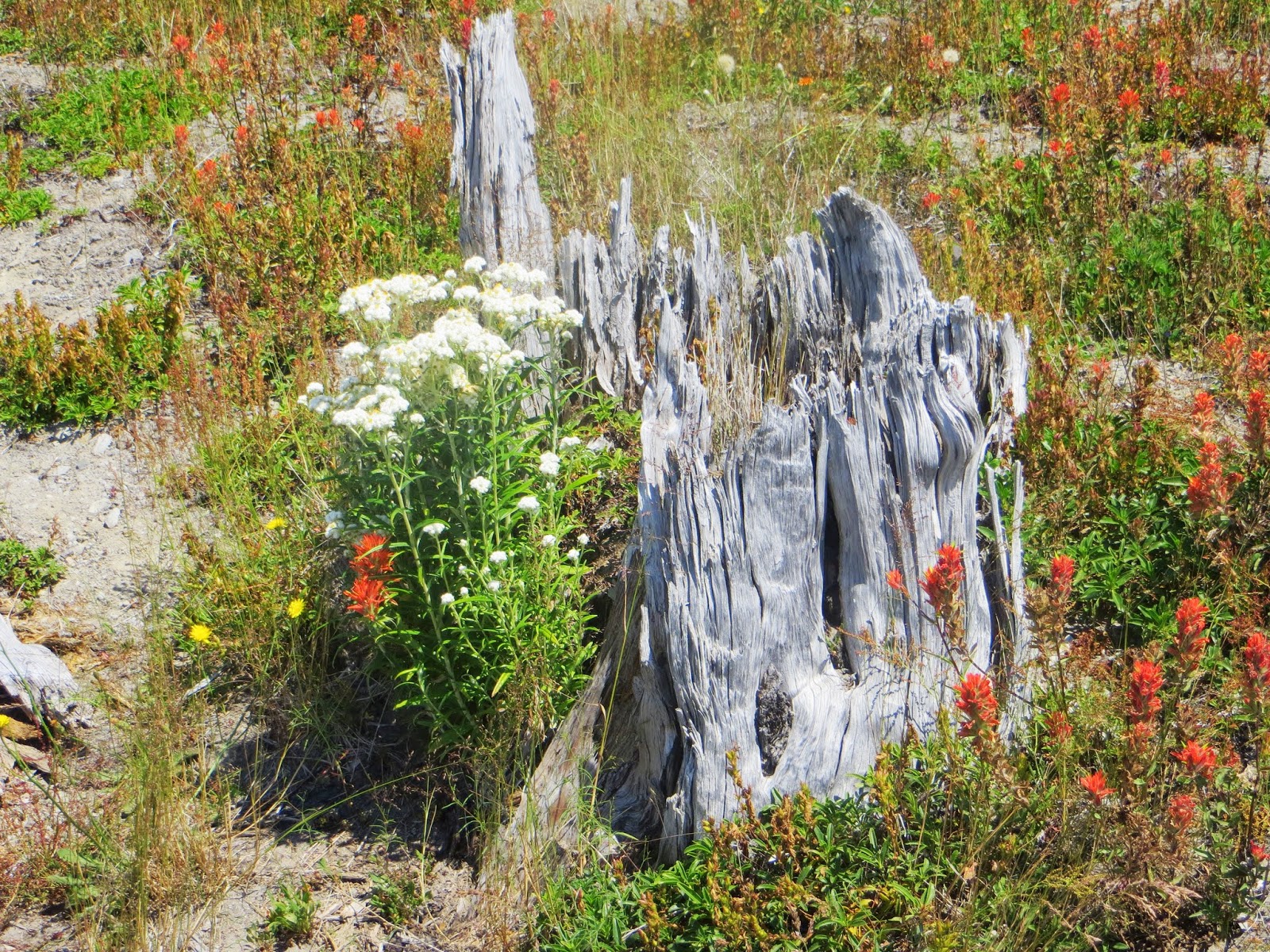
There were a lot of dried up stumps and tree trunks around.  They were the trees knocked over during the eruption.  In some of the dead trunks, there were flowers growing.  Below are two photos of fallen trees.


Far below us and in the distance, there were trees growing.  Where we were, though it was rocky, there were tons and tons of colorful flowers everywhere.  Below are some views of trees and flowers.


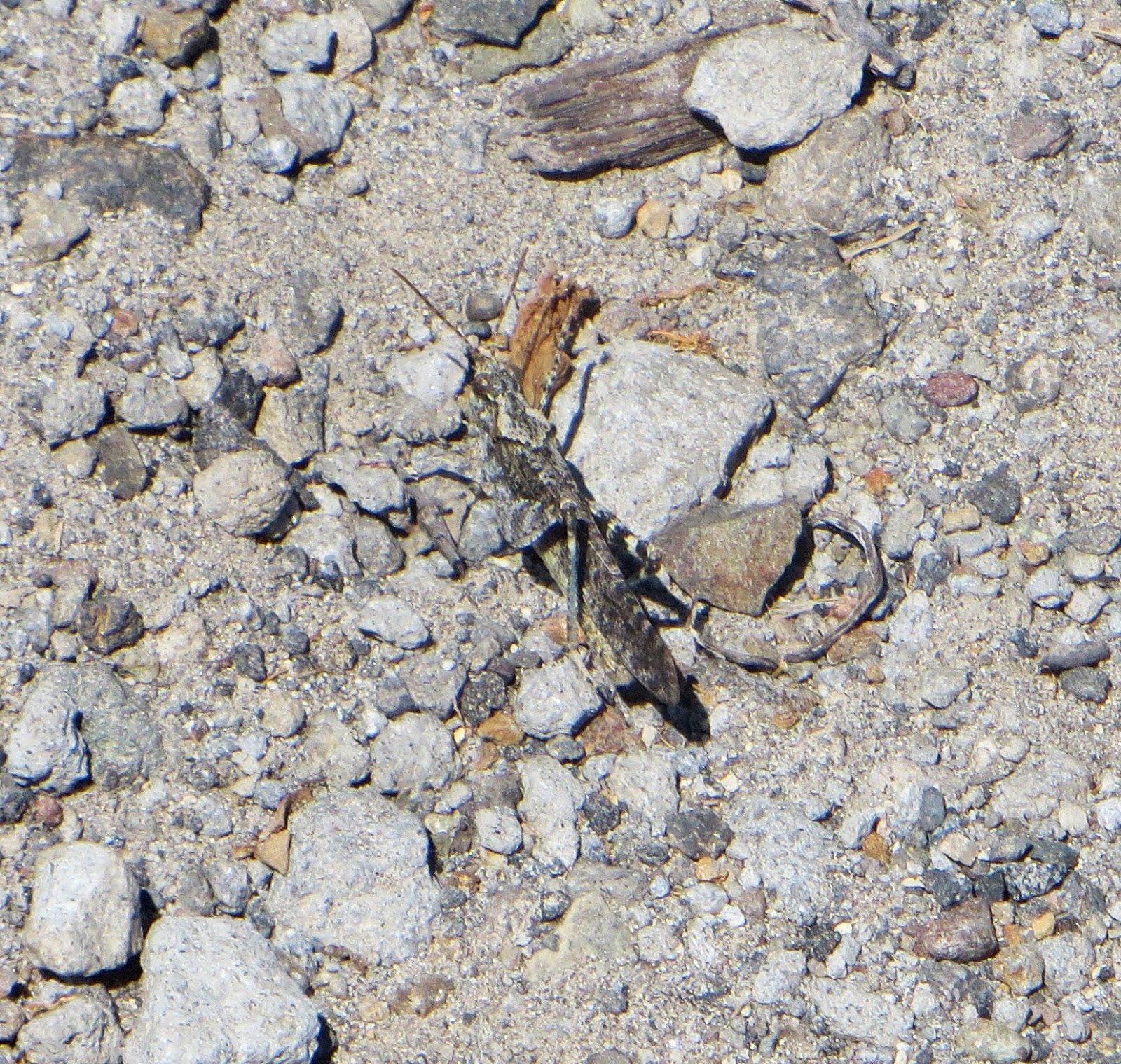
There were several different insects running and flying around.  One of them was a kind of grasshopper, though I don't know the species.  It was gray and blended in well with the rocks.  They would frequently fly into the air and I could see that they had a bright, electric green color under their wings.  When they landed it was incredibly hard to find them, even if I saw where they landed.  I did manage to take a photo of one of them.  Below is the photo.  If I can find out what species it is, I'll put it on the Insects and Arachnids page.

The only mammals we saw were golden-mantled ground squirrels.  They are found in the western United States.  They look similar to chipmunks, but have white eye-rings rather than stripes on their faces.  They have reddish-brown fronts and are gray on their backs and tails.  They have black and white stripes on their sides and are white below.  They are very beautiful ground squirrels.  Below is one of them.
Golden-Mantled Ground Squirrel

The only birds we saw at Mount St. Helens were a few ravens, swallows, and a kingbird.  The barn swallow was the most common swallow there.  They are found throughout Canada, the United States, and Mexico in the summer.  They winter in South America.  Their most distinguishing feature is their long forked tails.  They are dark blue on their heads, backs, and tails.  They have orange faces and are golden or light yellow below.  They have thin pointy wings.  As their name suggest, they often make their nests on barns or other man-made structures.  Below is a barn swallow.
Barn Swallow

We had to wake up very early for the flight back to San Diego.  I was tired, but the sunrise views from the airplane were very beautiful.  Below are a few of them.


Tuesday, August 27, 2013

Oregon and Washington Part 4

On Wednesday on our trip, we went to Pittock Mansion.  It is a fairly old house, but the people who had lived there were quick to get the newest technology, such as electricity.  It was a very large and beautiful mansion with nice views of mountains and Portland.  There were also nice pathways and it was surrounded by tall trees.  Early in the morning, or when there are few people around, there are probably many birds.  Even with all of the people there, I saw Wilson's warblers and Stellar's jays.  Below are three photos.  The first is of the mansion (the photo is just the top because the bottom was being repaired).  The second and third are of views around the mansion.


After the mansion, we went to the Portland Audubon Center, which is very close by.  There were a couple Wilson's warblers there; a male and a female.  Wilson's warblers are found in the northwest United States, Canada, and Alaska in the summer, most of the United States in migration, and south into Mexico in the winter.  They are found in woods near water.  They are very small and bright yellow below, and greenish-yellow on their backs.  Males have black caps while females have greenish-yellow that extends from their back to their head.  Below are three photos of them.  The first and third are of the male.  The second is of the female.
Wilson's Warbler
Wilson's Warbler
Wilson's Warbler

The center was very big and nice, and there was a window to view some bird feeders.  There was a hummingbird feeder and a suet feeder.  Below are two photos of Anna's hummingbirds at the feeder.  The first is a male and the second is a female.
Anna's Hummingbird
Anna's Hummingbird

There were also trails nearby.  We followed a few.  They led through a beautiful forest that looked like a rainforest.  It had very tall trees with long moss hanging off some of their branches, and there were large ferns everywhere.  It was also quite humid like a rainforest.  Below are four views from the trails.


We then went back to the center and saw many, many chickadees at the suet feeder.  There were mostly black-capped chickadees.  Below are four photos of them.
Black-Capped Chickadee

There were also chestnut-backed chickadees, which are very pretty.  They are found along the Pacific Northwest all year round in wet, mixed woods.  They have faded black and white faces (not as bold as black-capped chickadee), gray wings, pale chests, and reddish-brown sides and backs.  They are smaller than black-capped chickadees.  Below are two photos of them.
Chestnut-Backed Chickadee

We saw another Steller's jay there.  Steller's jays are found along the Pacific coast, in the Rocky Mountains, and down into Mexico all year round.  They are found in coniferous or mixed woods, often in the mountains.  They have tall black crests, black upper bodies, and blue bellies, wings, and tails.  Birds on the coast have blue marks on their foreheads, while the ones farther inland have white marks.  They are similar in size to western scrub-jays. Below is a Steller's jay.  The photo below wasn't taken in Oregon, because I wasn't able to get one there; I took the photo below at the Pinnacles in California.
Steller's Jay

After the Audubon center we went to a restaurant.  Out the window I saw an American robin that was catching either caterpillars or large grubs out of the grass.  They are found in Alaska and Canada in the summer, the United States year round, and the very southern United States south into Mexico in the winter.  Males are gray above and reddish below with darker faces with some white markings.  Females are more faded over all.  Below are two photos.  The first is the one is Oregon with the grub.  I believe is was a young one.  The second is a photo I took of one in Colorado that shows the colors a bit better.
American Robin
American Robin

Through our whole trip that day, we saw beautiful views of Mt. Hood.  Below is the one I thought was the best.  I took it while we were driving home.

Wednesday, August 14, 2013

Oregon and Washington Part 3

I am back from Washington now, but I will continue to post about the trip.  There will probably be one or two more parts after this one.

Two weeks ago on Saturday, we went on a trolley bus and took a short tour of downtown Portland.  We went to a Chinese garden and saw beautiful water-lilies and koi fish.  Below are three photos.  The first is of the trolley-bus, the second is a water-lily, and the third is of four koi fish.


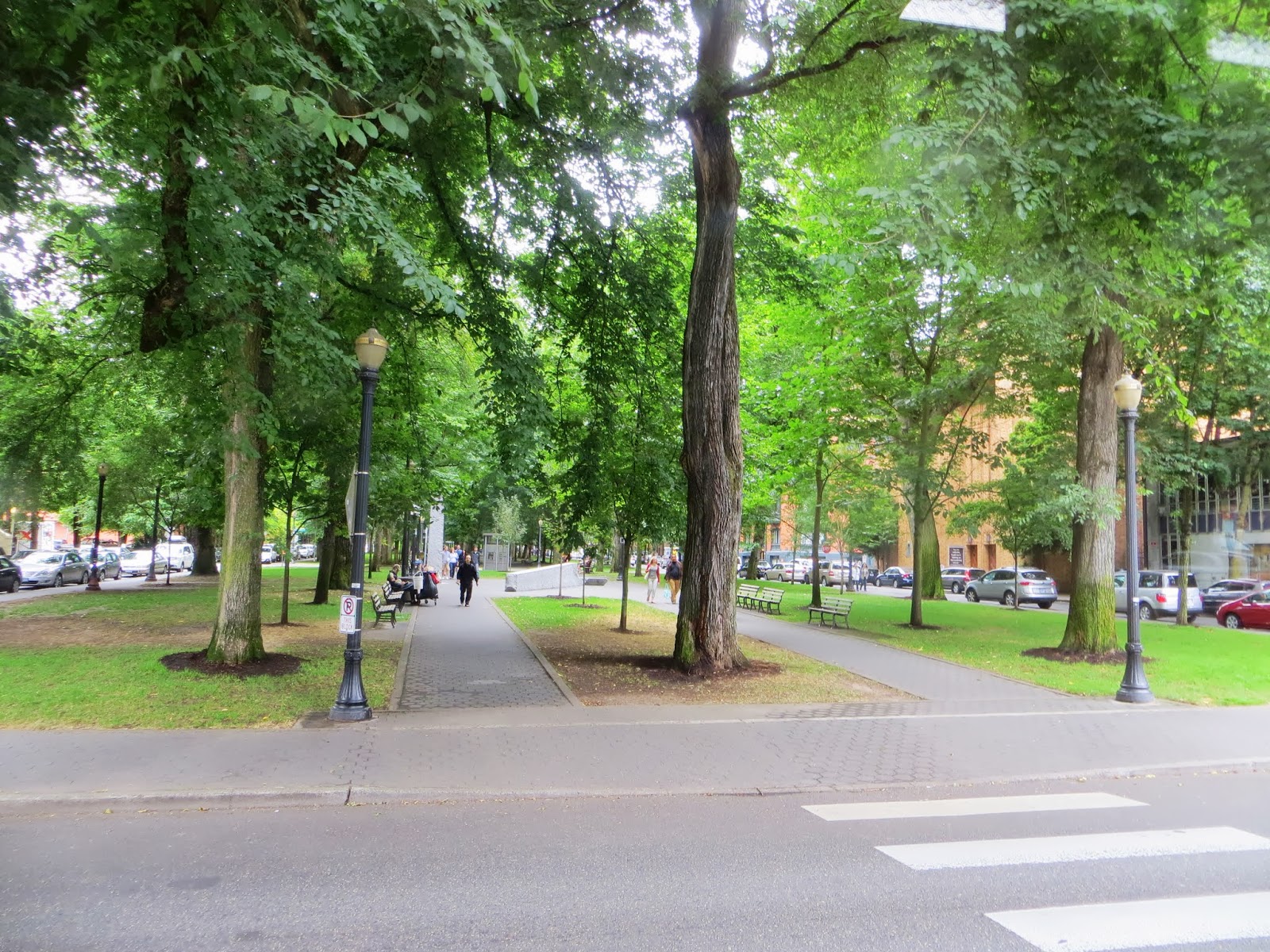
Portland is filled with trees; though, at most, these trees are only seventy years old.  Before that, nearly all of the trees in the area were cut down for the logging industry.  Fortunately, people are now a bit more careful, so there are a lot of trees again.  Below is a photo of a park filled with trees.


The next day, we went to Oaks Park, which is mostly an amusement park, but there are quieter picnic areas shaded by trees.  It is also right next to the Willamette River, so we had a nice view.  I looked for birds, but I only saw crows, a creeper, and some chickadees.  I think that there are probably more birds in the early morning and evening and when it isn't so hot.  Below is a crow sitting on a fence nearby our table.
American Crow

The chickadees were all black-capped chickadees.  They are the most common one in Oregon, though there are two other species there: the mountain and the chestnut-backed.  Black-capped chickadees are found throughout the northern United States, southern Canada, and southern Alaska all year round.  They are very common in any wooded habitat and are most often in groups of other chickadees or other songbirds.  Black-capped chickadees have black caps and throats, white faces and chests, tan sides, and gray backs.  Below is one chickadee that was in a small flock of about four.
Black-capped Chickadee

There were many beautiful trees and other plants around.  The trees near the picnic tables seemed to be the creeper's favorite, though I' not sure what they are.  There were also tall cottonwood trees.  The paths were lined with piles of the cotton, and plants nearby were coated with it.  It looked as if all the plants had thick cobwebs on them.  There were also more blackberries and very tall trees of different kinds.  Below are five photos.  The first is a tree by the table, the second is a view of the Willamette River, the third is cotton on a cottonwood tree, the fourth is a very tall tree (I don't what kind), and the fifth is blackberries.