Saturday, December 7, 2013

Buena Vista Lagoon November

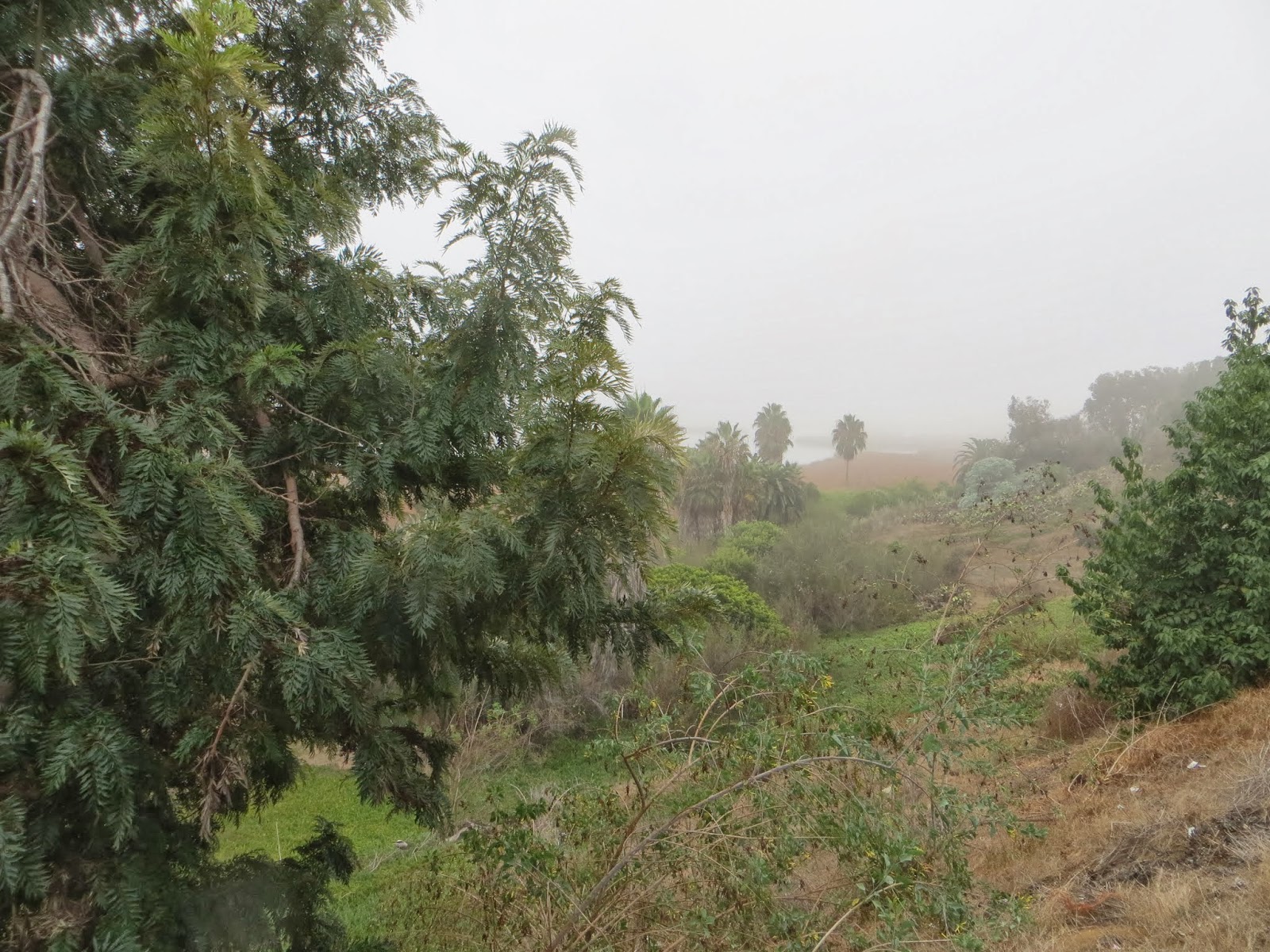
Last week was the Buena Vista Lagoon bird count.  It wasn't at all foggy like last month.  There were some clouds, but it was mostly clear.  Below are two photos of the lagoon when we first arrived.

One of the first birds I saw was an Allen's hummingbird.  From the front, it almost looked like a rufous, but on its back it was green.  Below is a photo of it.  (The green back can't be seen in this photo.)
Allen's Hummingbird

There were several common yellowthroats flitting around in the reeds and bushes.  Below is a photo of a male.
Common Yellowthroat

We didn't see as many double-crested cormorants as usual, but we did see a few.  Double-crested cormorants are found year-round all along the east and west coasts of the United States, including Alaska.  In the interior, they summer in the northern United States and southern Canada, and winter in the southeast down into Mexico.  They are the most common cormorant in the United States, and usually the only kind in the interior states, since most other species are pelagic.  They can usually be told apart from other cormorants by their larger size and orange face.  Below is a double-crested cormorant sitting on what seems to be a pipe sticking out of the lagoon.
Double-crested Cormorant

There weren't that many American coots at the lagoon.  There were only a few here and there.  Below is one of the coots.
American Coot

There were a few mallards swimming around taking baths.  Below is a male flapping its wings taking a bath.  The other ducks were nearby.
Mallard

There were hundreds of seagulls everywhere.  A lot of them were ring-billed gulls.  Below is part of a large flock circling over a shopping center.
Seagulls

An exciting sight was a merlin.  It was sitting on a dead tree beside the road.  We stopped so I could take a photo, and it turned out to be a very good view.  Below is a photo of it.  It had its leg tucked up.
Merlin

We went down to the beach.  Below is a view of the beach.

There were a few flocks of sanderlings running up to and away from the waves.  Sanderlings are found in the Arctic Circle in the summer and along the coasts of North and South America in the winter.  They are very pale with dark legs and beaks and patches on their shoulders.  In the summer they have reddish heads and chests.  Below is a group of six sanderlings.
Sanderlings

We saw an American kestrel as well as the merlin (both little falcons).  It was a male sitting on a telephone wire looking down at us.  Below is a photo of it.
American Kestrel

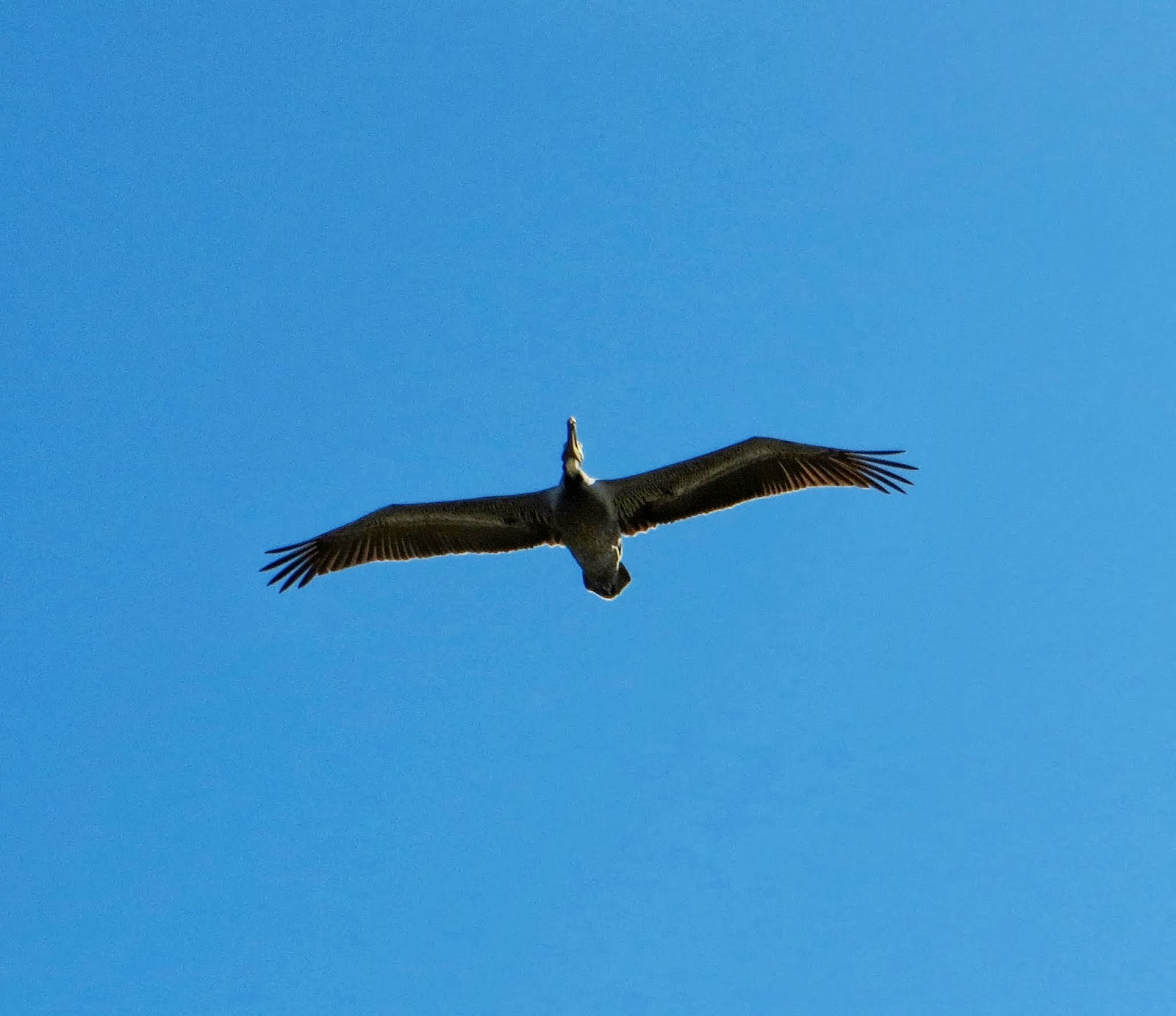
There were a few groups of brown pelicans flying over the ocean.  Below is one that was flying alone.  It looks very large with its wings fully spread.
Brown Pelican

There were only a few whimbrels.  There were perhaps two to four of them. Below are two of them with the waves behind them.
Whimbrels

Sunday, November 3, 2013

Buena Vista Lagoon October

Last Saturday was the bird count at the Buena Vista Lagoon.  It was very, very foggy and hard to see very far, as seen in the photos below at the first two stops.


I was walking along a path when I noticed that some of the reeds seemed to be moving on the other side of the water.  I watched, and saw that I little island of reeds was drifting down the middle of the water.  Below is the island, which is slightly redder in color than the reeds behind it.


The white-crowned sparrows have arrived for winter, and they are everywhere.  There were tons of them at the lagoon.  They have a very pleasant song.  Below is an adult white-crowned sparrow sitting on top of a lemonade-berry bush.  An immature one is sitting in the bottom left of the photo.  (By the way, lemonade-berry bushes have little red berries covered in a sappy-looking substance.  The substance is edible and tastes like lemonade.)
White-crowned Sparrow

For some reason, the water at the lagoon was incredibly still.  It looked just like a mirror.  Below a photo I that shows the reeds and how clear their reflections are.


We saw a black-throated gray warbler.  It was a new bird for most of us.  Black-throated gray warblers are found in the western United States in the summer, and Mexico and South America in the winter.  Unlike most warblers, they are entirely black, gray, and white except for two yellow dots between their eyes.  They are dark gray on their backs, white below, and have black and white streaked sides and faces.  They are found high up in trees in woodlands.  Below are two photos of the black-throated gray warbler.
Black-throated Gray Warbler

There used to not be that many northern mockingbirds at the lagoon, but now there seem to be tons of them.  Below is one that was singing on top of a bush.
Northern Mockingbird

Below is a black phoebe on a lamp post.  It looks very tiny sitting on top.
Black Phoebe


As we were driving, we saw a great egret standing in the middle of five swimming mallards.  It looked kind of funny to see such a tall, white bird among them.  It didn't quite fit in.  Below is a photo of the egret and ducks.
Great Egret and Mallards


There was a female northern harrier flying back and forth through the fog.  Below is a photo of it.
Northern Harrier


Below is a male common yellowthroat.  Usually they're hard to photograph (like most warblers) but this one came quite close to us.
Common Yellowthroat


There were tons of bushtits flying around, so I just took a ton of photos of groups of them, hoping at least one of the bushtits ended up in focus.  One of them did, and below is its photo.  It is a male (black eyes).
Bushtit


Below is another great egret standing on the edge of some reeds.
Great Egret


Below is another photo showing how calm and still the lagoon was.  There is a very tiny white dot on the edge of the reeds toward the right.  It's the great egret.


A red-tailed hawk was also flying around in the fog.  Below is a photo of it.
Red-tailed Hawk


Castor bean plants seem to be taking over everywhere.  They're incredibly invasive and poisonous, too, so please try to avoid letting them into your backyard.  Below is a photo of one of the plants.  They're very common near the lagoon, and grow very, very quickly.
Castor Bean Plant


The yellow-rumped warblers have returned in large numbers.  Below is one of them half hidden behind a dead plant.
Yellow-rumped Warbler


Oddly, the fog was very thick, then the sky almost cleared up, then the fog came right back just as thick as before.  Below are two photos of the lagoon where is was foggy, and when it was almost clear.


Cattail caterpillars are, as their name suggests, caterpillars that eat cattails.  They are very large, orange, black, and white caterpillars.  They turned into lovely, furry, white moths.  They are eating the cattails at the lagoon, which is a good thing, because the cattails are very much overgrown.  They are eating the reeds quite slowly, though.  Below is a photo of one of the caterpillars.
Cattail Caterpillar


There weren't that many western grebes at the lagoon, which was a bit strange.  Below is one the grebes.
Western Grebe


Below is an eared grebe.  When compared to the photo of the western grebe above, they look very similar.  Eared grebes are much smaller and grayer in the winter, though, and in breeding plumage, they are very, very different.
Eared Grebe

Sunday, October 20, 2013

Buena Vista Lagoon September

I'm sorry I haven't posted in a long while.  Unfortunately, it will probably continue to be this way because I'm very busy with school.

Three weeks ago was the Buena Vista Lagoon bird count.  We saw quite a few exciting birds and saw a lot of birds all together.  I saw a least bittern, but it was shy and disappeared into the reeds before I could take a photo.

I don't think we saw as many starlings as we usually do.  I'm not sure where they go, but they seem to come and go.  Below is one on a traffic light pole.
European Starling

It was pretty warm and sunny.  It wasn't great lighting for taking photos.  Below is the path behind the nature center in the sunshine.  That path is very good for seeing warblers, hummingbirds, thrushes, flycatchers, and spotted towhees, especially when there aren't many people around.  Those birds like the thick bushes.


At the second stop (in a restaurant parking lot that overlooks the lagoon), we saw a house wren and a Wilson's warbler.  Both of them were too quick to take photos of.  We also saw a white pelican and some hummingbirds.  Below is a female Anna's hummingbird visiting some flowers.
Anna's Hummingbird

There weren't as many lizards around as I thought there'd be.  There are usually a lot of them out on warm days.  I only saw one young western fence lizard.  I could tell it was young because it was very small with a large head.  Below is a photo of it.
Western Fence Lizard

For a while, we were a little worried because we weren't seeing very many herons or egrets, but this past bird count we saw pretty much every kind that we could see at the lagoon.  We saw great blue herons, great egrets, snowy egrets, a black-crowned night-heron, and a least bittern. Below is a photo of a great egret.
Great Egret

We saw our first white pelican of the fall.  It was swimming then flying by itself.  The rest of its flock were probably somewhere not too far away.  I might have said this before, but white pelicans are one of the largest birds in North America with a wingspan of nine feet.  They're very beautiful in flight with their black and white wings.  Below is a photo of the lone pelican.
White Pelican

We saw two ospreys at the lagoon.  One flew right over us and I was able to take a couple nice photos.  Ospreys aren't very common at the lagoon, so seeing two of them was pretty exciting.  Below are two photos of one of them.
Osprey
Osprey

We also saw a belted kingfisher, which is very uncommon there.  Belted kingfishers are found in Alaska, Canada, and the northern central United States in the summer, most of the United States all year round, and the southwestern desert portion of the United States south into Mexico in the winter.  They have large heads, crests, and long thick beaks.  Males and females have grayish-blue heads, backs, and bands across their chests, white bellies and collars, striped tails, and white below their wings.  Females have reddish brown sides and band across their bellies.  Kingfishers can be found in many habitats with open water and places to perch, where they hover and dive to catch fish.  Below is a female belted kingfisher.  It's not a very good photo, but some of its key features can be seen.
Belted Kingfisher

Yet another fairly uncommon bird was the eared grebe.  We actually saw quite a few of them. They were all in their non-breeding, gray, black, and white plumage.  Below is one of them.
Eared Grebe

We also saw Wilson's phalaropes.  Wilson's phalaropes summer in the northwestern and central United States and southern Canada.  The winter in South America.  They can be found everywhere in between during migration.  Phalaropes differ from most other birds in that the females are larger and brighter in color than males, and females will compete for and have multiple mates.  In breeding plumage, the females have white bellies, eyebrows, and chins, reddish-brown fronts, a thick black stripe down either side of their faces and necks, and gray and reddish-brown backs.  Both males and females have yellow legs and needle-like beaks.  In the winter, they are both pale-gray on their backs and chests with white faces and bellies.  Phalaropes, unlike many sandpipers, will often swim.  Below are two Wilson's phalaropes swimming.

Wilson's Phalaropes


We saw quite a few ruddy ducks.  Below are two females.
Ruddy Ducks


We also saw a female northern shoveler.  The winter ducks seem to have arrived a bit early this year; we also saw a blue-winged teal.  Below is the shoveler.
Northern Shoveler


I don't often see crayfish, at least not at the Buena Vista Lagoon.  However, at the last count, I saw one walking along the bottom of the water.  It briefly came to the surface and walked up a bank before heading back down and disappearing into deeper water.  I'm not positive what species it is, but it was about medium-sized and bright red.  Below is a photo of it.
Crayfish