


When we first arrived, a man pointed out a Red-tailed Hawk nest high up in a eucalyptus tree. He said he had seen two chicks, and that they were probably a couple weeks old. It was hard to see, since it was so high up, but we did see the two chicks, and later on, we saw a parent on the nest. The chicks were small, gray, and fluffy. Below are two photos of the nest. In the first, only one chick is visible. In the second, a parent is standing on the nest, and the head of one chick can be seen to the left (the top of the second chick's head can also be seen behind the parent, though it's difficult to see; it just looks like a lump).
 |
| Red-tailed Hawk |
 |
| Red-tailed Hawks |
We also saw Mallard ducklings. They were slightly older, though still very fluffy. They were bathing in the water. There were quite a few Mallards looking for handouts, drinking, bathing, and sleeping on the grass. Below are two photos. the first is of the two ducklings, and the second is a female Mallard (not the mother).
 |
| Mallards |
 |
| Mallard |
There were a few American Coots, though not very many. Below are two photos. The first is a coot swimming toward some people who were handing out bread to the ducks. The second is a coot (possibly the same one) swimming away from the people with a big chunk of bread in its bill.
 |
| American Coot |
 |
| American Coot |
There were several Pied-billed Grebes on the lake. Most were in very nice spring plumage. There were also a couple of young, fluffy grebes with boldly striped faces and pink bills. Below are two photos, one of an adult Pied-billed Grebe, and the other of a young one that was drifting across the lake, asleep.
 |
| Pied-billed Grebe |
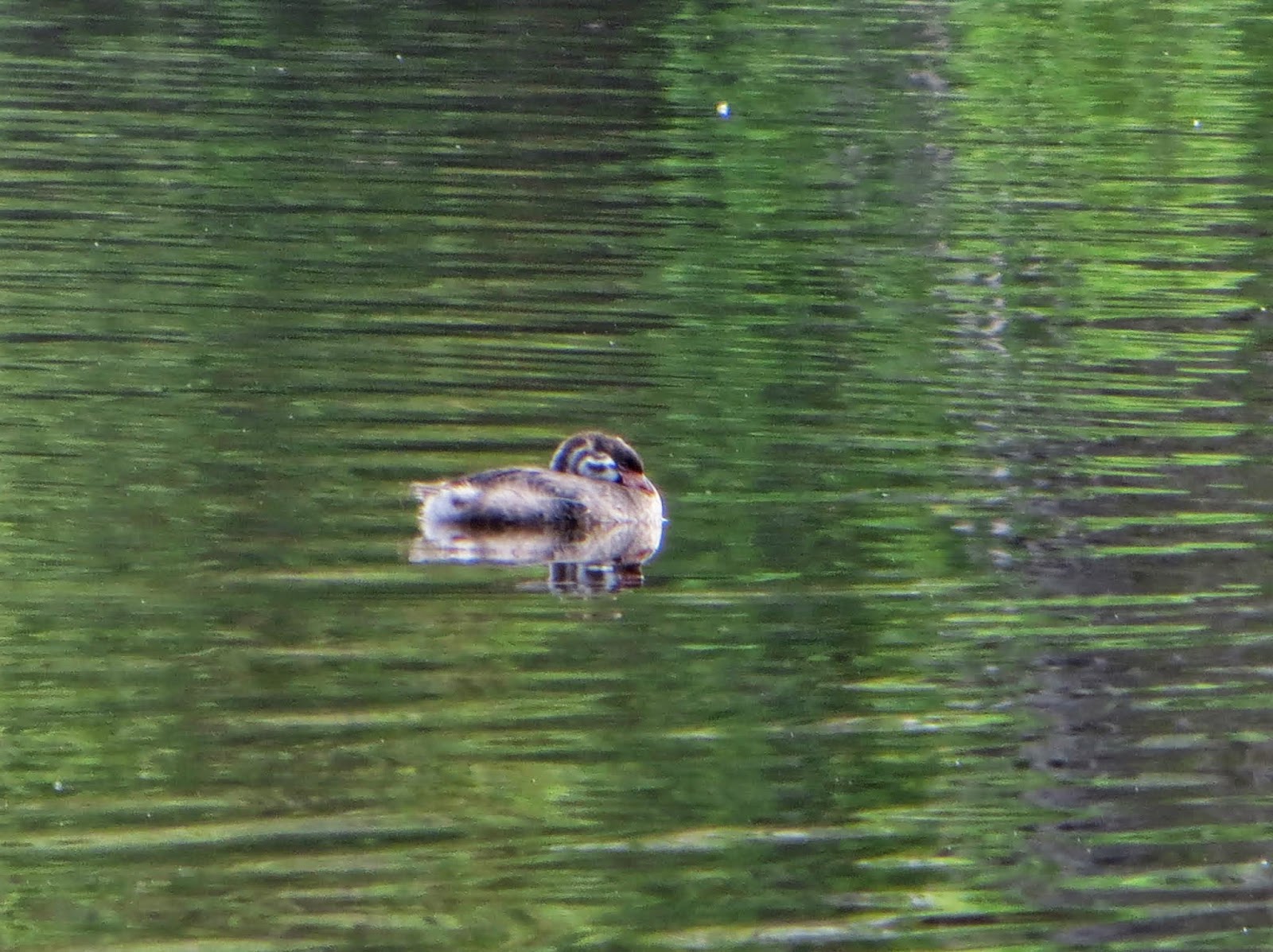 |
| Pied-billed Grebe |
The were many swallows flying around above the lake and the fields. They were all Northern Rough-winged and Cliff Swallows. As they always seem to do, some of the Northern Rough-winged Swallows perched on the tops of bushes and trees. Below is a photo of one of them.
 |
| Northern Rough-winged Swallow |
There weren't too many warblers around, but we saw a few here and there. We saw a couple of Yellow Warblers, but none stayed still long enough for a good photo. Below is a not-so-great photo of a male Yellow Warbler. It had nice, bold red streaks on its chest, though they can't really be seen in the photo. It blended in fairly well with the yellowish-green leaves.
 |
| Yellow Warbler |
There were a few lizards here and there, jumping around in the bushes (they can jump pretty high). Below is a photo of a Western Fence-Lizard.
 |
| Western Fence-Lizard |
Marsh Wrens don't often perch out in the open, but on Sunday we did see one sit still for a few seconds on top of the reeds. Marsh Wrens are found in the northern United States and southern Canada in the summer, and in the southern United States down through Central America in the winter. They are found year round in parts of the western United States and along the east coast. They are small and brown overall with lighter throats, white eyebrows, and streaks on their upper backs and tails. They are almost always found near water, and are more often heard than seen. Below is a Marsh Wren sitting atop the cattails.
 |
| Marsh Wren |
There were a few Song Sparrows around, shuffling on the ground or singing in the bushes. Below is a Song Sparrow foraging in the middle of the path.
 |
| Song Sparrow |
There were also quite a few hummingbirds around, mostly Anna's Hummingbirds. Below are two photos of male Anna's Hummingbirds.
 |
| Anna's Hummingbird |
 |
| Anna's Hummingbird |
There was a surprising number of Black-headed Grosbeaks. I don't think that we had seen them at Guajome before. We saw at least four of them, both males and females. They very bright and beautiful in their spring plumage. Below is a photo of a male grosbeak, showing its bright orange feathers and black and white tail.
 |
| Black-headed Grosbeak |
We saw a couple of Say's Phoebes. The one below was hunting for insects on the ground amid a crowd of squirrels (the squirrels had moved when I took the photo, however).
 |
| Say's Phoebe |
We saw a rather unusual sight at Guajome (well, we thought it was odd). We saw two birds perching right near each other in the bushes, and I thought they were both the same species at first (they were close to the same size and both looked dark from a distance). It turned out that one was a Cassin's Kingbird, and the other was a California Thrasher. I wouldn't have expected them to hang out so close together, but there they were. Below is a photo of the two (kingbird above, thrasher below).
 |
| Cassin's Kingbird and California Thrasher |
There were a couple of flocks of Lesser Goldfinches foraging atop the trees. Below is a female.
 |
| Lesser Goldfinch |
There were quite a few Spotted Towhees. I'm not sure that I've ever seen so many in one place. There always seemed to be at least one nearby, usually 'singing' at the top of a tree or bush. Their song is an odd buzzing trill. Below is a Spotted Towhee singing.
 |
| Spotted Towhee |
There were a lot of Desert Cottontails at Guajome. There were groups of them grazing on grass, and some in the bushes. Below is one of them that was near the trail, but completely ignored us as it nibbled on a plant.
 |
| Desert Cottontail |
As we were walking on the trail, I noticed something moving back and forth very quickly across the ground. It was a small (maybe half an inch to three-quarters of an inch), unusual looking bug; some sort of arachnid. It was digging a hole with its head, then gathering up the dirt and pushing it across the ground away from the hole. After some research, I discovered that it was a wind scorpion (I don't know what species; there are over a hundred in the United States). They aren't scorpions, but their own separate group. They aren't poisonous, but can bite. They're very quick, and are mostly nocturnal. I'm not sure why the one I saw was digging a hole; maybe it was trying to build a burrow. It was very interesting to watch. Below is a photo of the wind scorpion pushing dirt.
 |
| Wind Scorpion |
There were a few Western Scrub-Jays around, but not very many. Below is one of them high up in a tree.
 |
| Western Scrub-Jay |
As I said earlier in this post, there were a lot of California Ground-Squirrels. There were at least a few running around everywhere we walked. There were so many holes in the ground that a squirrel sitting anywhere seemed to only need to run a few feet before disappearing into the ground. Below are three photos of the squirrels.
 |
| California Ground Squirrel |
 |
| California Ground Squirrel |
 |
| California Ground Squirrels |
Every time we go to Guajome, we always see Western Bluebirds in the trees or fields near the entrance to the park. However, we didn't see any this time until the very end, when we saw one flying between the trees. It finally stopped and sat on a branch, letting me take a photo. Below is the bluebird (a female).
 |
| Western Bluebird |


