Showing posts with label Batiquitos Lagoon. Show all posts

Sunday, February 15, 2015

Huntington Beach, San Elijo, and Batiquitos

Today we went up to Huntington Beach to visit relatives and have brunch. After we ate, we walked out onto the pier to have a look at the ocean. It was a warm, clear day (clear enough to see Catalina Island), though we could see clouds approaching in the distance. Within minutes, the clouds were much closer and it soon became so foggy we couldn't see the end of the pier. Below are a few photos to show how quickly the fog moved.


As I was taking photos of the ocean, an immature California Gull snuck into one of the pictures. Below is the gull.
California Gull

Looking over the edge of the pier, I saw a group of dark birds in the distance that I thought were gulls at first. However, as I looked more closely, I realized they were Surf Scoters. Some more flew in right below me, and looking over the other side of the pier, there were many more. Below are three photos of Surf Scoters.
Surf Scoter
Surf Scoter
Surf Scoter

Yesterday we went to the San Elijo and Batiquitos Lagoons. We didn't walk very far, but we saw a surprisingly large number of birds within a small area. Below are three views from the second floor of the San Elijo nature center (in the second and third photos, the rooftop garden is visible).


The first bird I saw was right in front of the nature center making "wee" sounds. It was a little California Gnatcatcher hopping around inside a bush. California Gnatcatchers are found in coastal sagebrush scrub in southern California and Baja California. They are tiny gray birds with black tails and white eye-rings. In breeding plumage, males have a black cap. The California Gnatcatcher is currently listed as Threatened due to habitat loss. Below are two photos of the gnatcatcher (sorry they aren't very good; it refused to come out into the open).

California Gnatcatcher
California Gnatcher

One bird we saw that we hadn't seen in a long while was a Blue-winged Teal. Blue-winged Teals are found in Alaska, Canada, and the northern United States in the summer. In the winter, they're found in the southern United States down to northern South America. Males have reddish brown bodies spotted with black, black tails, white hip-patches, and gray heads with a white crescent shape near the bill. Females are patterned brown with dark eye-lines and pale around the bill. Below are two photos. The first is of a male and female, and the second is just the male.

Blue-winged Teals
Blue-winged Teal

We saw a couple of Orange-crowned Warblers up in a tree above us. Below is a photo of one.

Orange-crowned Warbler

Because it was a warm day, a lot of lizards were running around. Most were Western Fence-Lizards. There is a surprisingly large amount of variation between the individual Western Fence-Lizards. They can range from brown to gray to almost black and have stripes or spots or just be plain. Below are three photos of very different Western Fence-Lizards (the third was a particularly beautiful one).

Western Fence-Lizard

There were also a lot of grasshoppers jumping around. I never noticed them until they hopped out from under me. Below are two photos of them.


There were a few hummingbirds buzzing about. Below is an Anna's Hummingbird.

Anna's Hummingbird

There were also a few egrets crouching along the shore hunting or just sitting. Below are two Snowy Egrets.

Snowy Egret
Snowy Egret

There was a group of swallows and White-throated Swifts flying together at the Batiquitos Lagoon. I believe the swallows were all Northern Rough-winged Swallows. One of them flew down to land in a dead tree. Below is a photo of it.

Northern Rough-winged Swallow

There were a few Caspian Terns flying around. Below are three photos of them.

Caspian Tern
Caspian Tern
Caspian Tern

There was one male Bufflehead right near us that dove over and over and over again. It probably spent more time underwater than it did above water. Below are two photos of it.

Bufflehead
Bufflehead

There were two Cinnamon Teals, a male and female. They were pretty far away, but even from a distance we could see the male's beautiful cinnamon feathers. However, I was not close enough to take a great photo. Below are two photos of the male.

Cinnamon Teal
Cinnamon Teal

There was one lone Long-billed Curlew on the shore near some ducks. It just stood there and for a short while it stretched its wings and legs. Below are two photos. The first is of it stretching, and the second is of it with a American Wigeon.

Long-billed Curlew
Long-billed Curlew and American Wigeon

There were groups of Double-crested Cormorants at both lagoons. Below are two photos. The first is of a cormorant swimming, and the second is of cormorants and Western Gulls.

Double-crested Cormorant
Double-crested Cormorants and Western Gulls

There were a lot of ducks at the Batiquitos Lagoon, though most were probably American Wigeons. Below is one of them.

American Wigeon

We had a very nice view of a pair of Red-tailed Hawks as we left the lagoon. They flew right above us. Below is one of them.

Red-tailed Hawk

There were many Lesser Goldfinches around singing in the trees. Below is a very bright male Lesser Goldfinch in a jacaranda tree.

Lesser Goldfinch

Tuesday, March 25, 2014

Batiquitos Lagoon

Today my dad and I went to the Batiquitos Lagoon in Carlsbad.

The weather was cloudy and cool.  It wasn't great weather for birdwatching or taking photos, but we still saw plenty of birds, and the views were beautiful.  Below is a view of the lagoon.


There were many red-winged blackbirds flying around.  Below is a beautiful male who came fairly close to us.
Red-winged Blackbird

There were quite a few herons and egrets around.  There was one black-crowned night-heron in a tree and several great blue herons, great egrets, and snowy egrets.  Below are two photos.  The first is of a great blue heron, and the second is of a great egret and a great blue heron.
Great Blue Heron
Great Egret and Great Blue Heron

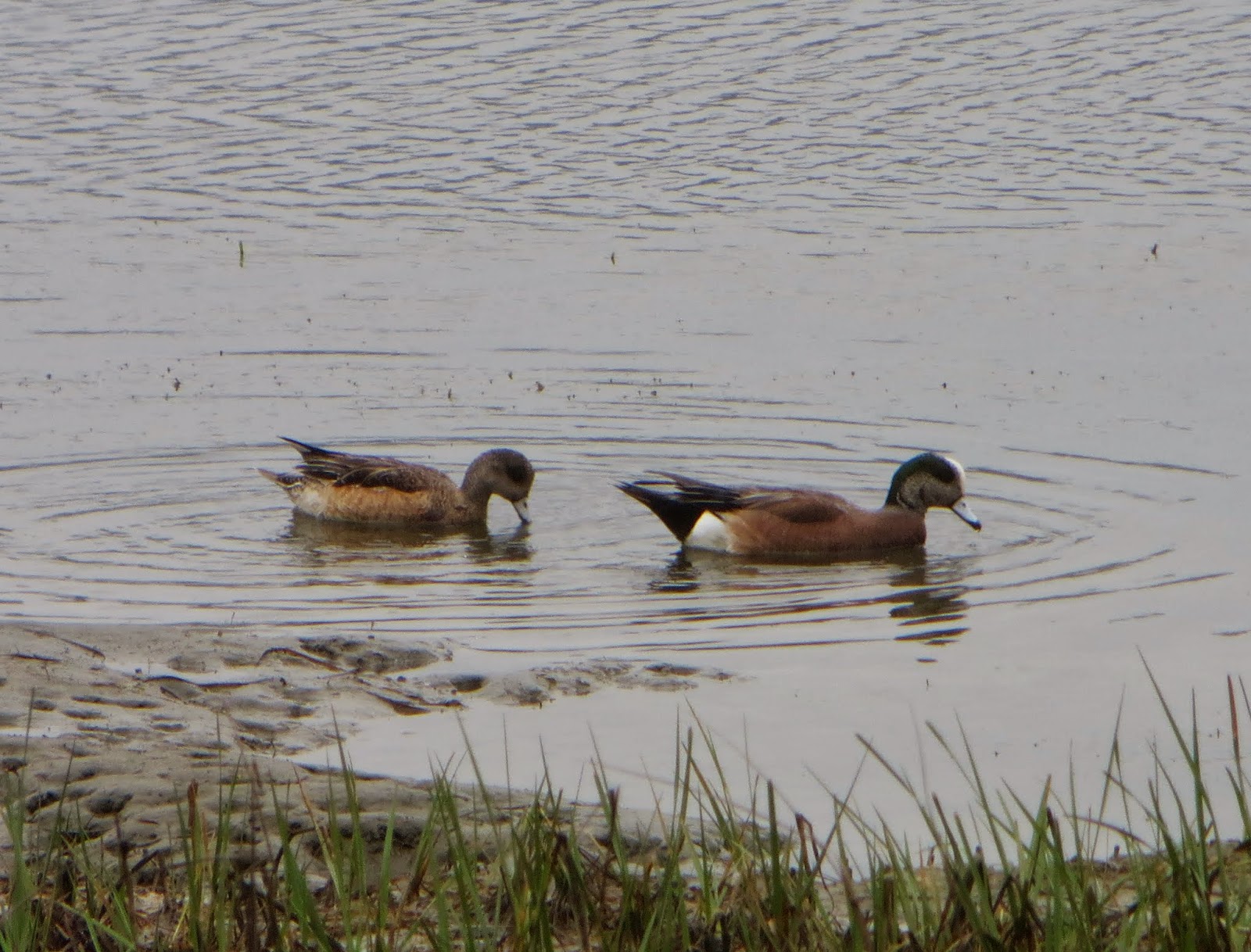
There were many, many American wigeon on the lagoon.  The American wigeon is found in Alaska, Canada, and the northern United States in the summer, and southern United States, and Mexico, and northern South America in the winter.  Males are reddish-brown above and white below with black tails.  They have white wing patches, dark green eye patches, and white foreheads.  Females have brown tails and unmarked brown heads.  They are very common on ponds, and will also graze in fields.  Below is a photo of a male (right) and a female (left).  The white forehead is probably the most distinctive feature; there are no other common ducks in the United States with white foreheads.
American Wigeon

There were a lot of different sandpipers around.  There were least sandpipers, willet, and marbled godwit.  Marbled godwit are found in the northern central United States and southern Canada in the summer, and along the southern coasts down into Mexico in the winter.  They are large and brown with reddish-brown under their wings and dark eye stripes.  They have long black legs and long, upturned bills.  There were quite a few of them at the lagoon.  Below are two photos of one.
Marbled Godwit
Marbled Godwit

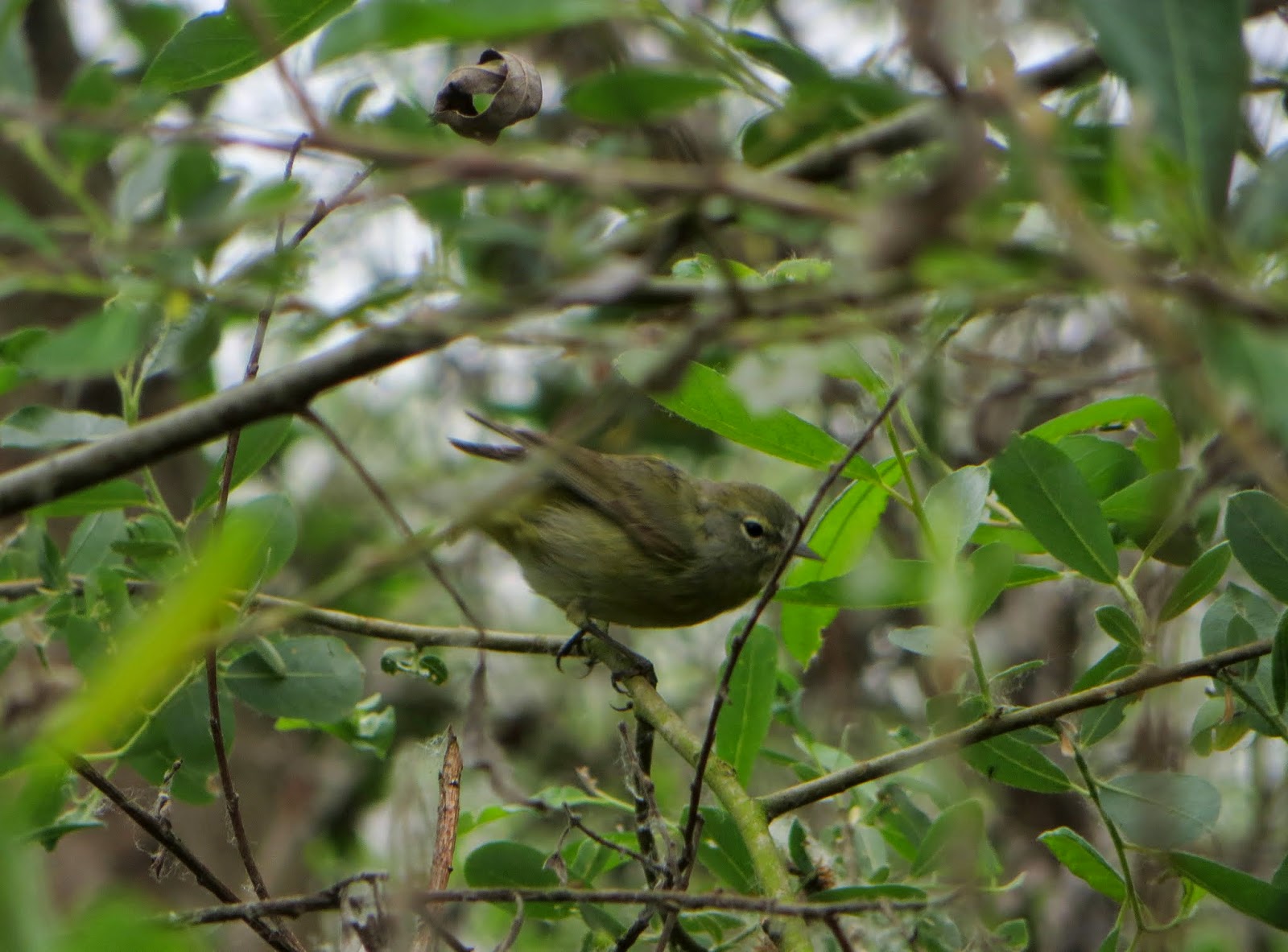
As we were walking along a trail, there were quite a few sparrows and warblers flitting through the trees and bushes.  Below is a rather dull-colored orange-crowned warbler.
Orange-crowned Warbler

Out of all the many ducks we saw, only one was a northern pintail.  It was swimming among the wigeon and coots.  Northern pintails are found in Alaska, Canada, and the northern United States in the summer, the southern United States, Mexico, and northern South America in the winter, and parts of the western United States all year round.  They are also found in parts of Asia, Europe, and Africa.  They have very long, pointed tails and long necks.  Females are brown on their heads and backs and white below.  Males have dark brown heads, white necks, white bellies, gray backs, and black tails.  They can be found in flocks, but I've only ever seen one or two at a time.  Below is the male northern pintail.
Northern Pintail

Most of the sandpipers at the lagoon today were willets.  They were moving around in large flocks.  Below is one of them.
Willet

At one point, a flock of sandpipers (probably willets) joined a flock of pigeons.  They flew together in a mixed flock for a while as if they were all the same species.  Below is a photo of them just as they were joining together.  The sandpipers are in the top right.
Rock Doves and Willets

There was an osprey flying around the lagoon for a little while.  There may have been two.  Below is a photo of one flying.
Osprey

There was a belted kingfisher hunting for fish as well as the osprey.  I think it was a male.  Below is the kingfisher sitting on a dead tree.
Belted Kingfisher

At one point, the kingfisher and the osprey were sitting on the same telephone wire.  It was a very long wire that stretched all the way across the lagoon from one hill to the other.  It was very, very high above the water, so I think the two birds were just sitting; they weren't looking for fish at the moment.  Below is a photo of the two fishing birds.
Belted Kingfisher and Osprey

As the tide went out, groups of birds gathered on the mudflats.  There was a group of gulls of different species, a group of double-crested cormorants, and a group of Caspian terns.  Below are three photos of those groups in that order.  Some terns are mixed in with the gulls, and there is a brown pelican in the middle of the cormorants.
Gulls and Caspian Terns
Double-crested Cormorants and Brown Pelican
Caspian Terns