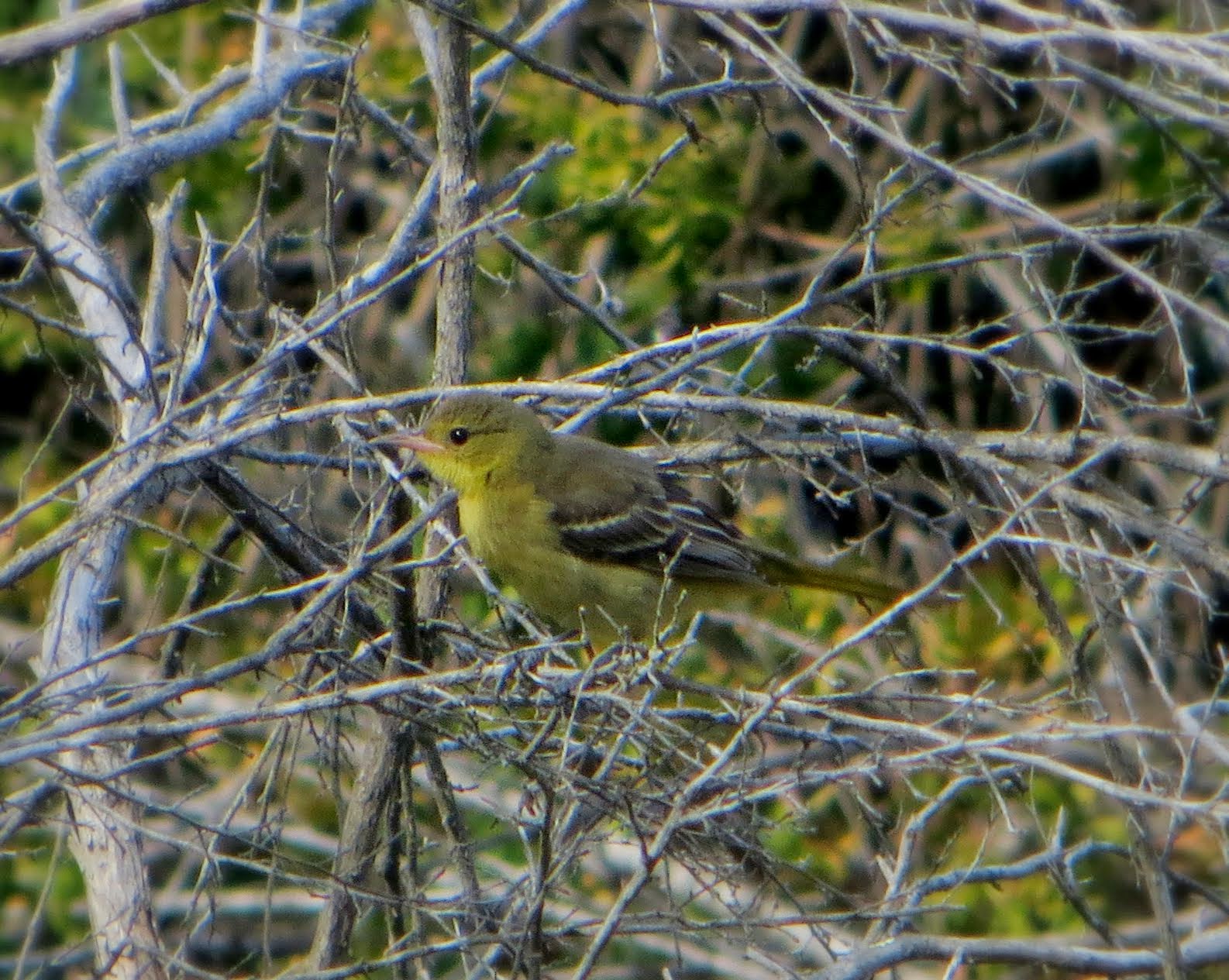
A lot of birds have been visiting our backyard these past couple months. It's been especially hot this summer, and we put out several bowls of water outside, so many different birds have been coming down to drink, bathe, and cool off. Just sitting by the window, I can see quite a few species within a short period of time. Most of the summer birds - the grosbeaks, tanagers, and orioles - are still here, and come down to the water from time to time. Below are three photos. The first is a female Black-headed Grosbeak. The second is of the same grosbeak, along with a female House Finch, both a male and a female Hooded Oriole, and a female House Sparrow. The third photo is of a female Western Tanager (which looks very similar to a female oriole, but is stockier with a thicker yellowish bill, shorter tail, and darker wings) and a California Towhee.
Black-headed Grosbeak
Black-headed Grosbeak, House Finch, Hooded Orioles, and
House Sparrow
Western Tanager and California Towhee
Little warblers have been visiting the water as well. Most often it's an Orange-crowned Warbler, but once or twice I've seen a Yellow Warbler taking a drink there. Below are three photos. The first is of an Orange-crowned Warbler and a California Towhee, and the second two are of the same Orange-crowned Warbler bathing and showing off its bright orange crown.
California Towhee and Orange-crowned Warbler
Orange-crowned Warbler
Orange-crowned Warbler
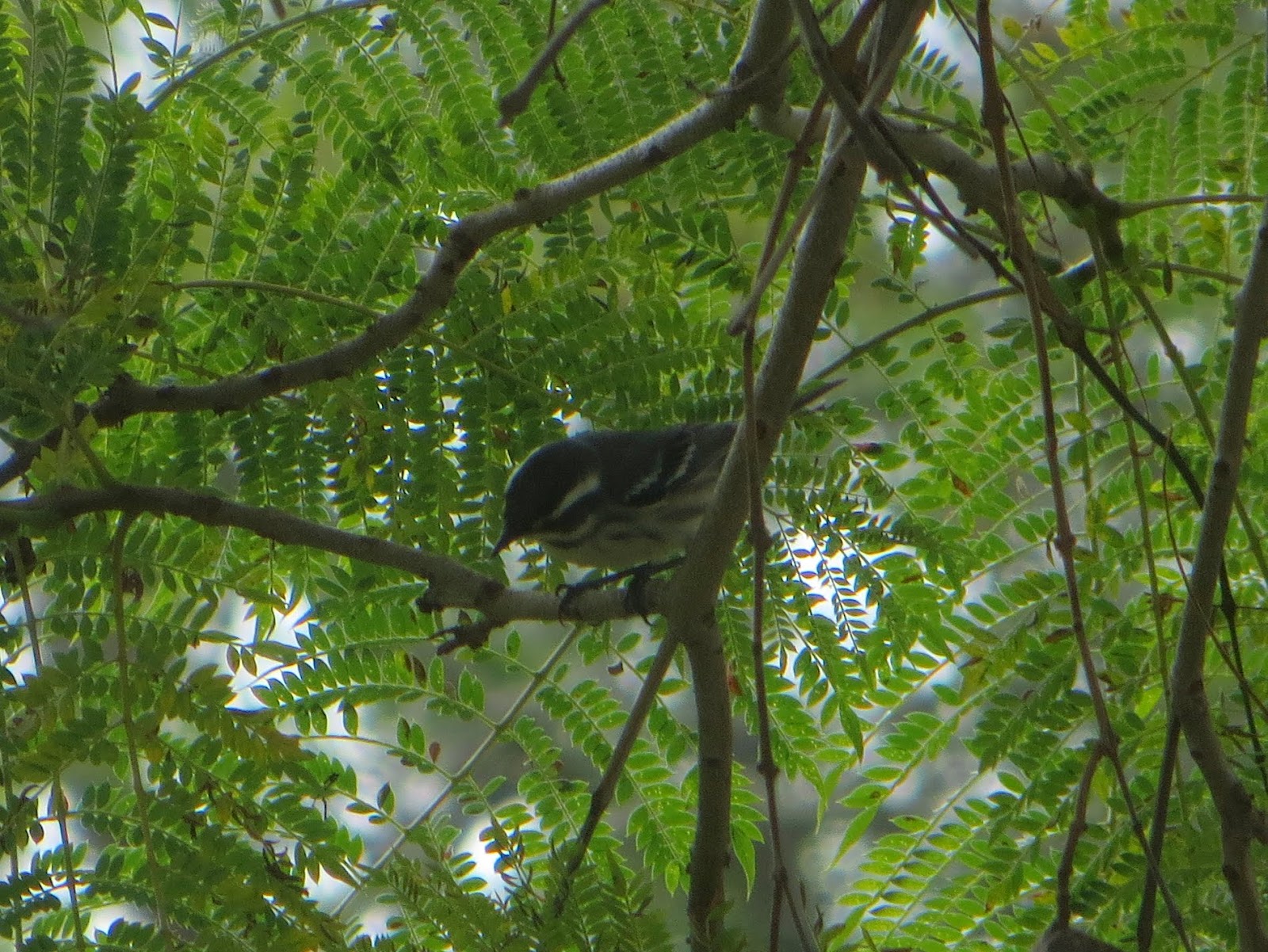
As I mentioned in my last post, a few winter birds have arrived very, very early. On Saturday, I spotted another new migrant in my yard, the Black-throated Gray Warbler. I've never seen them in my yard before, and I haven't seen them anywhere this early before. Like most of the birds in my yard, it came down to take a drink, though it didn't stay long. A couple of Mountain Chickadees also came by, though they didn't stay long enough for a photo. Although the chickadees don't migrate, I don't usually see them except in the winter. I'm still not sure why these birds have come here so early. Below are two photos of the Black-throated Gray Warbler in the jacaranda tree.
Black-throated Gray Warbler
Black-throated Gray Warbler
I also saw a couple of little flycatchers on Saturday, the Pacific-Slope Flycatcher and the Western Wood-Pewee. Because of their similar size and shape, they can be confused at a distance or in bad lighting. In good lighting, the Pacific-Slope Flycatcher is clearly very yellow, while the Western Wood-Pewee is grayish-brown (it does have a small bit of yellowish-gray on its belly). Below are two photos. The first is the Pacific-slope Flycatcher, and the second is the Western Wood-Pewee.
Pacific-Slope Flycatcher
Western Wood-Pewee
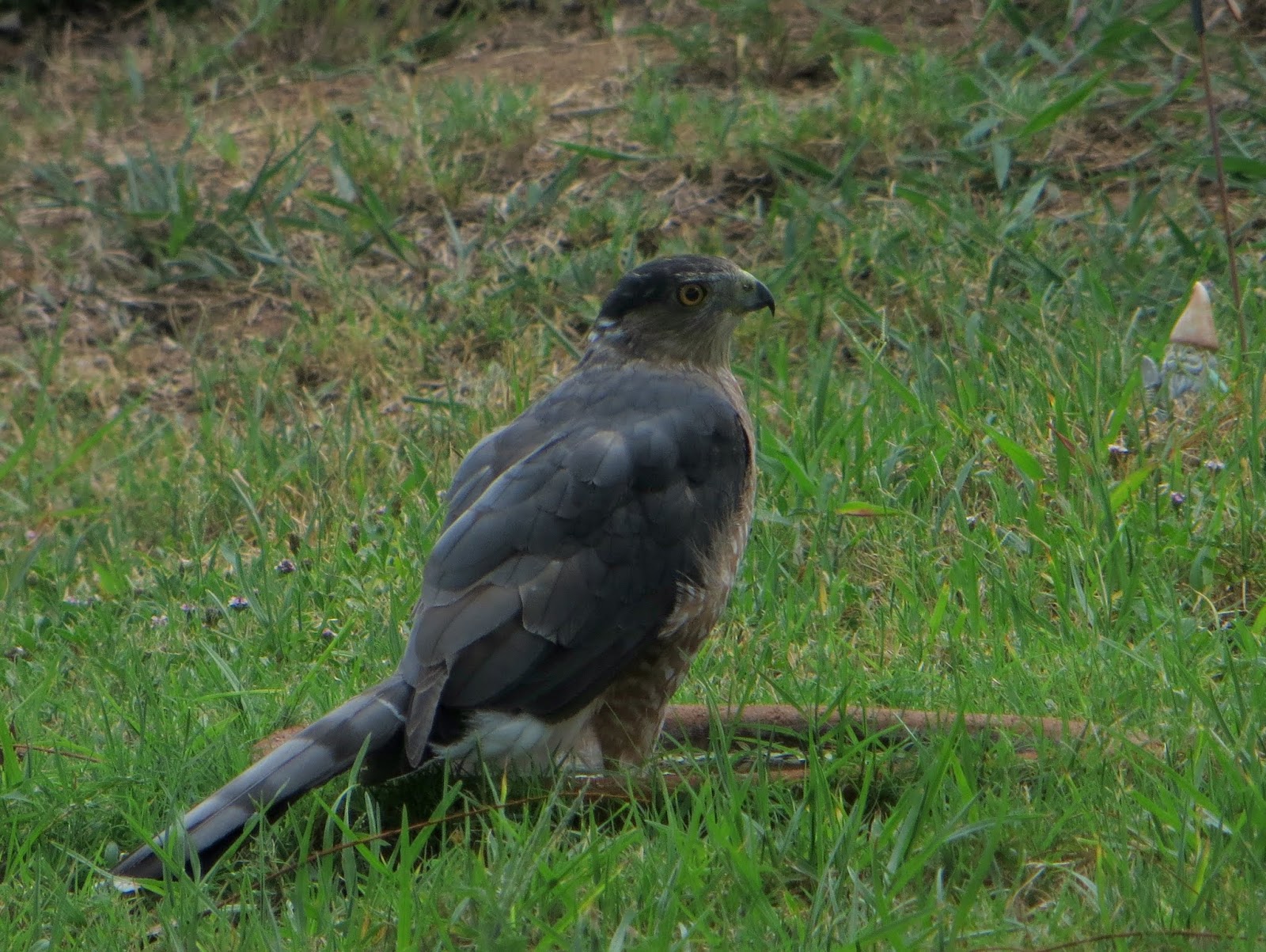
On Thursday, I was doing my homework and looked up to see an adult Cooper's Hawk standing in the middle of the yard. It was just standing in the grass, looking around. Then it raised its wings a couple of times, as if warding off anything that might be nearby. It ran to one of the clay water dishes, took a drink, and sat in the water. It stayed for quite a few minutes before taking off. However, it must have been weighed down by water or maybe it was difficult to take off from the ground, since it didn't quite make it over a bush and sort of fell into it. After it righted itself and sat for a minute or two, it flew away. Below are six photos of the Cooper's Hawk. The second and third are of it raising its wings, the fifth is it sitting in the water, and the sixth is the hawk when it fell into the bush.
Cooper's Hawk
Cooper's Hawk
Cooper's Hawk
Cooper's Hawk
Cooper's Hawk
Cooper's Hawk
On Saturday, a juvenile Cooper's Hawk came by. It was trying to hunt, and flew from perch to perch trying to find a way to get to a group of House Sparrows hiding in a bush. It was clearly very unexperienced, as it tried to jump into the bush and climb in after the birds. The hawk was way too big to fit into the dense bush, and so it fell out onto the ground. It tried a second time with the same result, then sat in an orange tree for a while before finally flying away. Below are three photos of the hawk. In the first, the hawk is sitting on a birdbath, in the second, it's on our roof, and in the third, it's in the orange tree (its bill is open because it was panting; it was very hot on Saturday).
There is a young cat living in our yard that is fascinated by the skunks (there are now four or five skunks that come every night). She doesn't interact with them, but sits a few feet away or hides in the bushes and watches them. Sometimes she follows them around. The cat is always there when the the skunks are. Below is a photo of a skunk and the cat.
Whenever Cooper's hawks are on the move, they always fly quickly and often crazily. They never seem to sit still for very long. Below is a photo of one sitting on a telephone pole.
Cooper's Hawk
The California towhees must be molting, because all of them are very patchy. The one below isn't too bad, but some of them look like small patches of feathers are missing.
California Towhee
Every day, a lot of birds come down to take baths in the various water bowls. Orioles, towhees, finches, house sparrows, mockingbirds, goldfinches, doves, and jays all come down and bathe there. Below are six photos of birds that came down to bathe. The first two are of both house finches and house sparrows. The third is a northern mockingbird, and the four and fifth are hooded orioles. The sixth is a mourning dove (it may have been a young one, because of the patchy marks on the face and barring on the chest and back).
House Sparrows and House Finches
House Sparrows and House Finches
Northern Mockingbird
Hooded Oriole
Hooded Oriole
Mourning Dove
A rather odd incident occurred at the metal water dish. There was a fluffy young lesser goldfinch sitting there on the edge. Then a female house sparrow came down and sat beside it. The goldfinch began to cheep and flap at the house sparrow, begging it for food. Surprisingly, the house sparrow did feed it. Perhaps, because house sparrows are very small, it resembled an adult goldfinch to the baby, and because the behavior of most young birds is very similar, the house sparrow automatically wanted to feed the baby. I'm not sure, but that's the best I can think of. It was very strange, but cute, too. Below are three photos. The first is the house sparrow (the goldfinch can be seen in the background), the second is the young lesser goldfinch, and the third is the house sparrow feeding the goldfinch.
A lot of finches have been hanging around the yard, eating the grass seeds that have come up. Below is a male house finch.
House Finch
We usually don't see very many mourning doves around, but one day there were quite a few sitting on the telephone line, and more just kept coming. It was nice to see so many, though I don't know what made them all suddenly get together. Below are twelve of the mourning doves.
Mourning Doves
Every once in a while I'll see or hear a hooded oriole. Their song is strange and warbling, and sometimes sounds like a mockingbird. Hooded orioles will sometimes mimic other birds, similar to mockingbirds. Below is a young hooded oriole (notice the pale edges on the beak).
Hooded Oriole
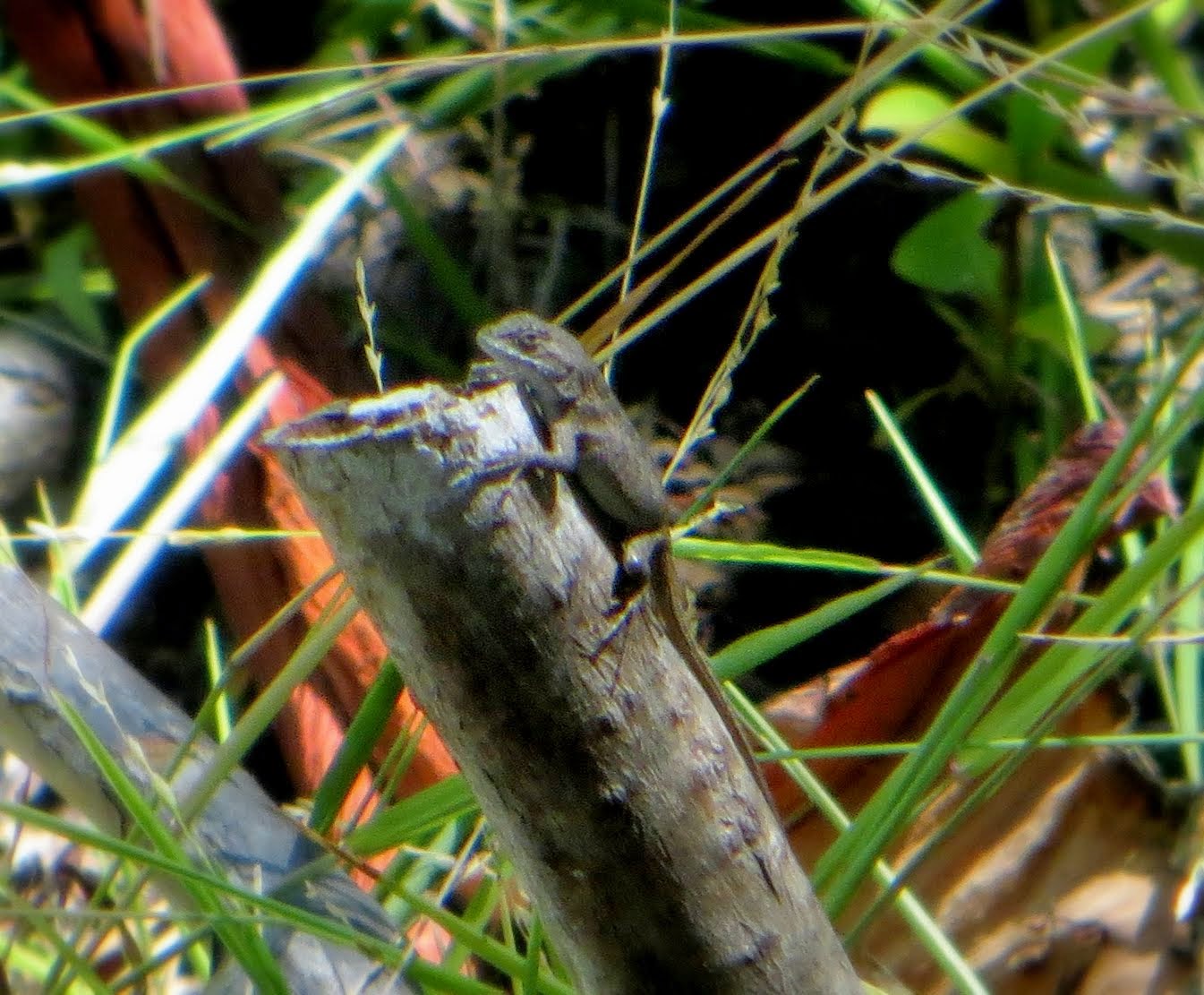
There are many young lizards around; mostly western fence lizards. The young ones are very tiny. Including the tail, many of them are about the length my finger. Below is one of the young western fence lizards.
Western Fence Lizard
There are two or three young western scrub-jays hanging around. They eat a lot of the catfood. Below are two photos of them (notice the brown or dull-colored heads).
Western Scrub-Jay
Western Scrub-Jay
There is a young California towhee that often visits the catfood bowls with its parent. Despite all of the catfood lying around in front of it, it still waits to be fed. The parent will take a large piece of catfood out of the bowl, then break it with its beak. It will then pick up each piece of broken catfood and hand them to the baby one by one. Below are two photos of them. The parent is on the right in both photos.
California Towhees
California Towhees
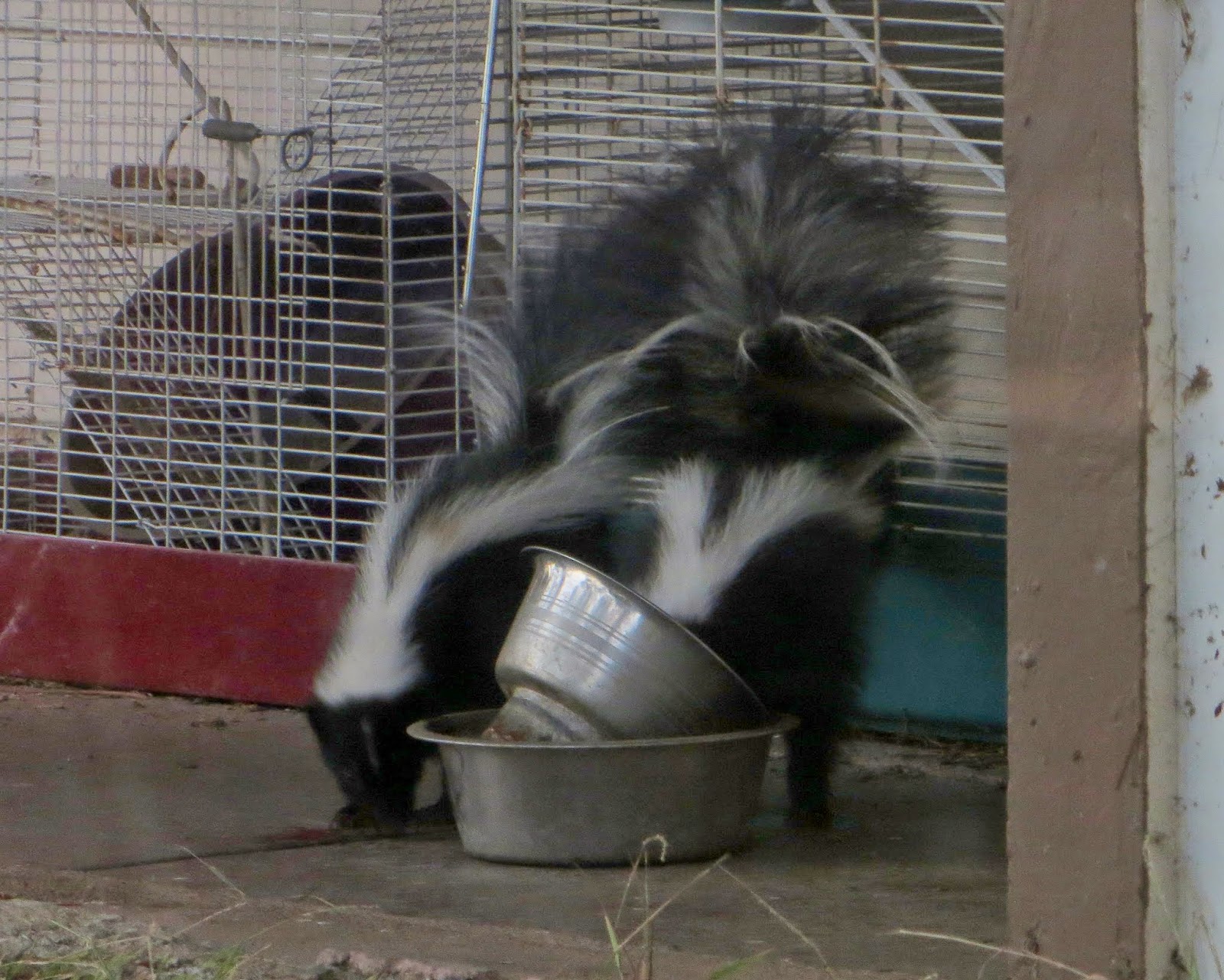
The striped skunks still visit the catfood bowls every day. The mother skunk doesn't visit very often, but the two young ones always come. We always know when they're around because they make a loud clatter with bowls when they eat. We think they might be living in a concrete tube in our yard. Below are three photos of the skunks.
Striped Skunk
Striped Skunk
Striped Skunks
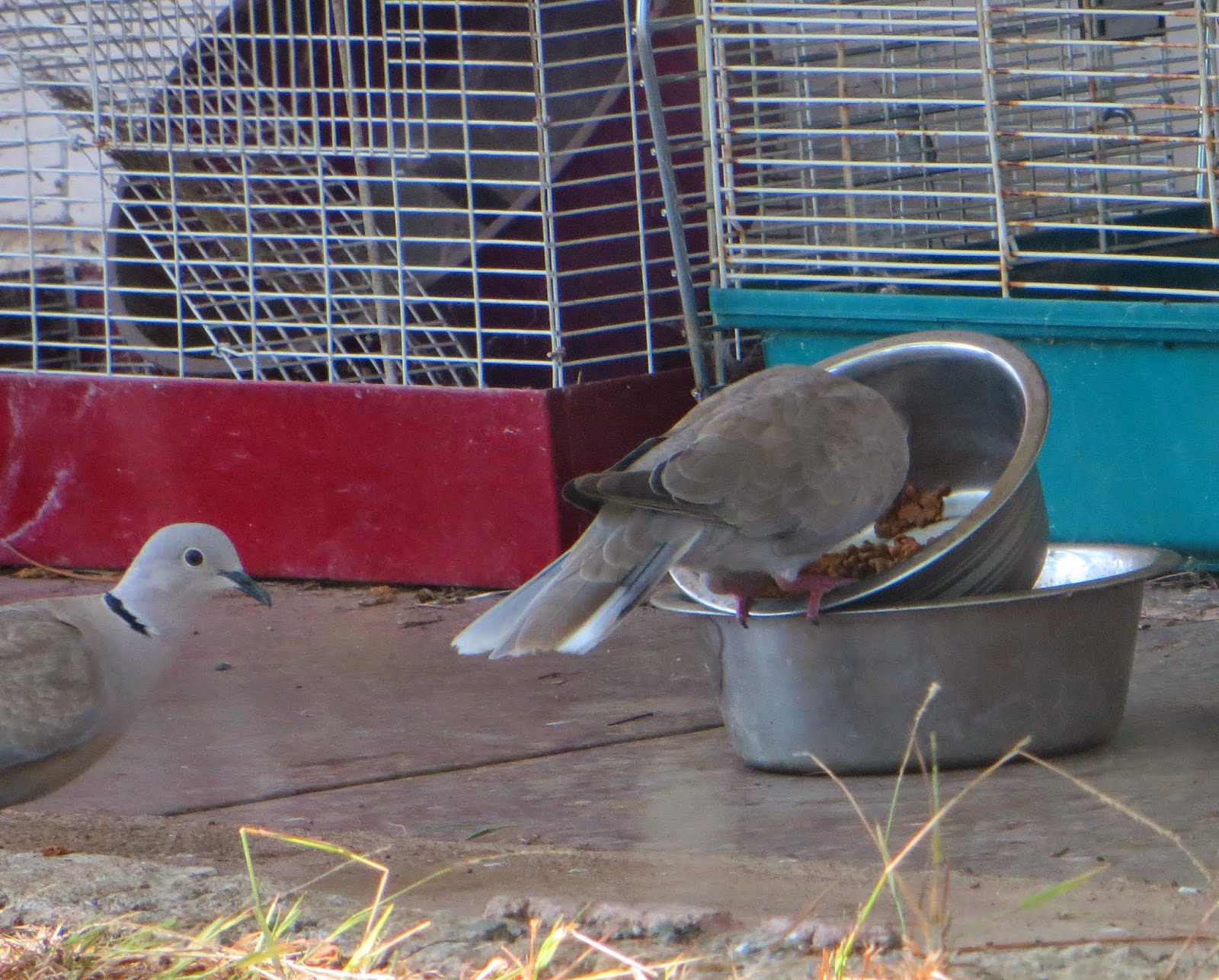
The Eurasian collared-doves still visit the catfood. They've figured out how to balance and keep the bowl from rolling and swinging around. They often come in a pair. Below are two photos of the two doves at the food bowls.
Recently, a striped skunk living in our yard raised two little babies. I don't see the mother that often, but every night, the two young skunks visit the cat food bowls. They are very small and very beautiful with their bold black and white fur. Below are four photos of them.
Striped Skunk
Striped Skunk
Striped Skunk
Striped Skunk
Another somewhat surprising visitor to the food bowls is a Eurasian collared-dove. I wouldn't have thought that doves would eat cat food, but I suppose they need their protein, too. Since the collared-dove it so big, it often has trouble balancing and tips the bowl over. Below are two photos. The first is of the dove near the cat food bowl and the second is of it at a water bowl (it almost fell of that bowl, too).
Eurasian Collared-Dove
Eurasian Collared-Dove
The young black phoebe from spring still hangs around our yard. For a long while, it wasn't able to catch any flying insects, so all it did was land on the ground and catch pill bugs. I think it can catch the other insects, but it still eats a large amount of pill bugs. Below are two photos of it.
Black Phoebe
Black Phoebe
The California towhees must have had another nest, because there is a young bird that hangs around sometimes, begging its parents for food. Below is a photo of it sitting on a bench.
California Towhee
There seem to be a lot of young animals in our yard right now. A few days ago, we saw a young spotted towhee scratching on the ground. They look a bit strange; not very much like adults. They have dark heads, backs, and tails and a tan patch below with white spots on their wings. They are much duller than adults, and they are covered in dark streaks. Adults have no streaking. Below is the young spotted towhee.
Spotted Towhee
A couple weeks ago there was a very pretty adult Cooper's hawk perched on a telephone pole. Below is a photo of it standing on one leg.
Cooper's Hawk
Below is a video I filmed of a northern mockingbird. In the video, it is singing and displaying by hopping up and running along the top of the telephone pole.