Tuesday, June 9, 2015

San Luis Rey River

Sorry that this post is really late (and out of order). I was very busy.

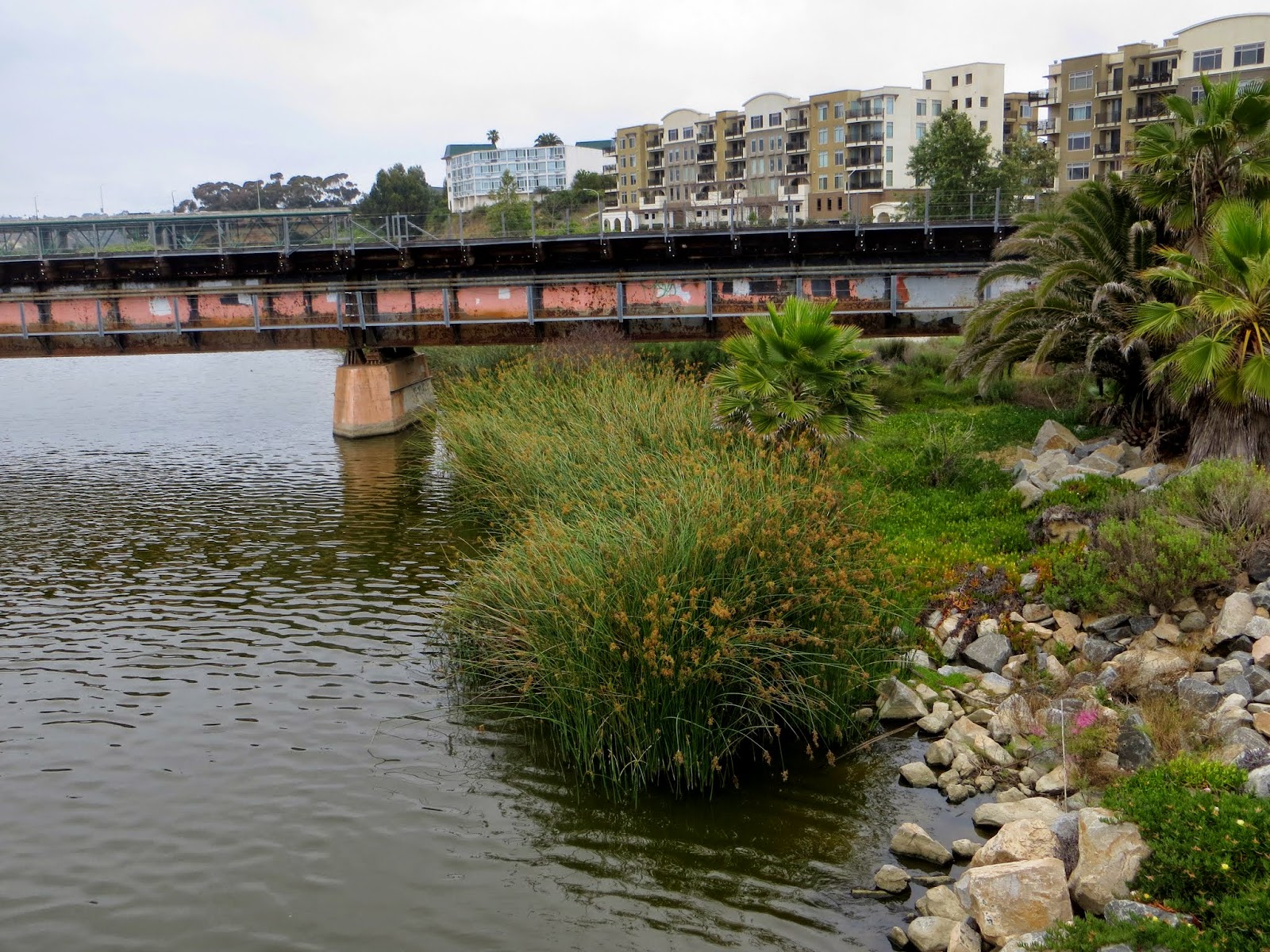
On Monday, May 25, my dad and I went birdwatching at the mouth of the San Luis Rey River. It was very cloudy for much of the day. We walked along a bike trail. Below are five views from a bridge and along the trail.

There were a lot of Black-crowned Night-Herons. They were all crouched in the reeds along the shoreline. Below are three Night-Herons (the third one is immature).

Black-crowned Night-Heron

There were a few Ruddy Ducks swimming along. They were very difficult to photograph, as they seemed to dive underwater every few seconds. However, I did manage to photograph them. Below are two photos. The first is a male in very striking breeding plumage, and the second is a female.

Ruddy Duck
Ruddy Duck

A Cooper's Hawk flew over the river and a large flock of blackbirds, grackles, and a few others chased it. In the end, only one red-winged blackbird continued chasing it. Below are three photos of the blackbird following the hawk.

Cooper's Hawk and Red-winged Blackbird

There were quite a few Great-tailed grackles. Male grackles look surprisingly large up close. They're a lot larger than females (a few inches longer and about twice the weight). Their iridescent plumage is also very beautiful up close. Below are two photos of male Great-tailed Grackles.

Great-tailed Grackle

There were a few Pied-billed Grebes floating around, including a couple of young ones with striped faces. Below are two photos of Pied-billed Grebes. The first is a young one, and the second is an adult.

Pied-billed Grebe
Pied-billed Grebe

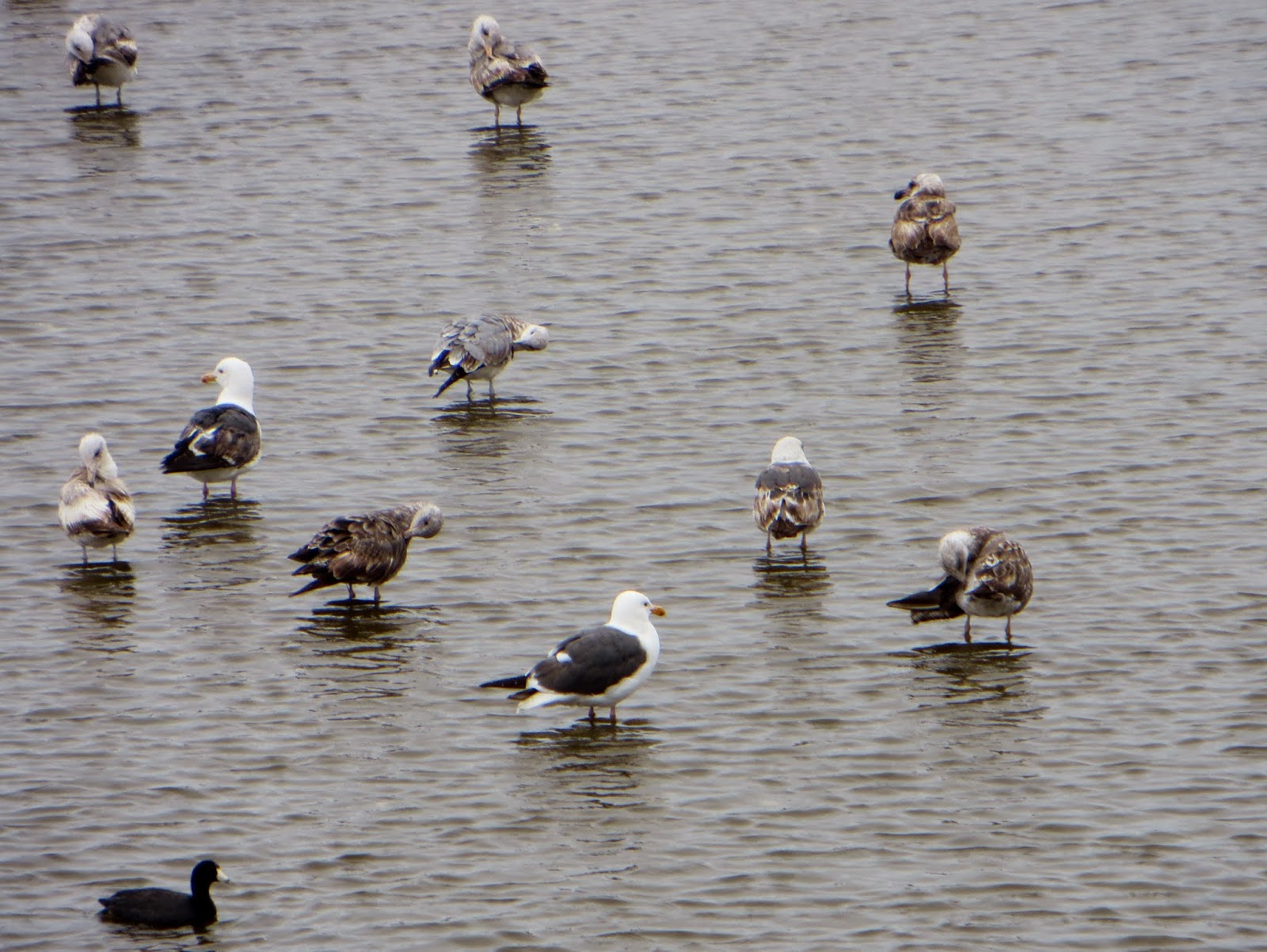
There was a large flock of Western Gulls standing in the water. A few other birds were moving around in the flock as well. Below are two photos. In the first are twenty-eight Western Gulls, an American Avocet (bottom left), and a Black-necked Stilt (bottom right). In the second are ten gulls and an American Coot.

Western Gulls, Black-necked Stilt, and American Avocet
Western Gulls and American Coot

A large flock of Brown Pelicans flew over the ocean in a long V shape. There were probably about twenty-five to thirty pelicans in the flock. Below are three photos of them.

Brown Pelicans
Brown Pelicans
Brown Pelicans

There were a couple of American Avocets. They seemed to be a pair, and had a couple of fluffy gray chicks, one of which became confused and followed a Killdeer around for a while. One of the adult avocets seemed very determined to make a wide open space for itself and chased away all of the stilts and gulls from that space. American Avocets are found in the western United States and southern Canada in the summer, and in the southeastern United States, Mexico, and part of Central America in the winter. They are found in southern California and southeastern Texas all year round. They are very distinctive with their white bodies, black and white wings, long bluish-gray legs, and thin, upturned bills. In the summer, their heads and necks are reddish colored, and in the winter they are gray. Below are seven photos of the avocets. The first two are the two adults (the darker-colored one was the more aggressive one). The next three photos are of one of the adults chasing away three different gulls. The last two are of the chicks (in the very last photo, the chick is following the Killdeer).

American Avocet
American Avocet
American Avocet and Western Gull
American Avocet and Western Gulls
American Avocets and Western Gulls
American Avocet
Killdeer and American Avocet

There were also several Double-crested Cormorants and Caspian Terns. Two of the terns appeared to be in a pair. Below is a photo of a couple of gulls, three cormorants, and two terns (the terns are only barely visible behind the bushes to the right of the photo).

Double-crested Cormorants, Caspian Terns, and Western Gulls

Looking back over my photos, I discovered an odd bird in one of them that I hadn't noticed before. It was a Brant, a type of goose. When I took the picture, it had blended in with the Double-crested Cormorants so I hadn't noticed it. Brants are found along the east and west coasts of the United States and northern Mexico in the winter, and in the Arctic Circle in the summer. They are fairly distinctive geese with mostly dark bodies and wings, white "necklaces," and white tails. The amount of gray and white varies from bird to bird. Some have grayish wings and sides, or white patches. The one in my photo had white patches on its sides. Below is the photo. The Brant is the bird at the far right. Also in the photo are two Western Gulls, the pair of Caspian Terns, three Double-crested Cormorants, and a Black-necked Stilt (its head is poking out from behind the piece of wood near the top of the photo). This may have been the most species I've ever captured in one photo.

Western Gulls, Caspian Terns, Double-crested Cormorants,
Black-necked Stilt, and Brant

There were only a couple of Gadwalls at the river, a male and a female. Below is a photo of them.

Gadwalls

There were a few Snowy Egrets around. Two of them may have been a pair, since they seemed to be foraging together. Below are three photos of them. In the second photo, there is a Northern Rough-winged Swallow flying by in the corner.

Snowy Egret
Snowy Egret and Northern Rough-winged Swallow
Snowy Egrets

There were quite a few Northern Rough-winged Swallows, as well as some other swallows. Some of them may have had nests under a bridge. Below is one of the Northern Rough-winged Swallows perching in the reeds.

Northern Rough-winged Swallow

There were a few Song Sparrows around, and I took a photo of what I thought were Song Sparrows, but turned out to be Lincoln's Sparrows (I made mistakes like this one and the one with the Brant because I wasn't really using my binoculars). Below are two Lincoln's Sparrows.

Lincoln's Sparrows

There were quite a few Black-necked Stilts at the river. Two of them were in a pair and had a little fluffy chick. One of the parents was scolding my dad and me very loudly. Black-necked Stilts are found in the western and southern United States in the summer and parts of Central America in the winter. They are found along the southern coasts of the United States as well as much of Mexico and parts of South America all year round. They have a very striking black and white plumage. They have black backs and wings, white fronts, and a white spot above either eye. To me, their pattern is somewhat reminiscent of an orca. They also have black, needle-like bills and extremely long, thin red legs. Below are seven photos of the stilts. The last three are of the chick.

Black-necked Stilt
Black-necked Stilt
Black-necked Stilt
Black-necked Stilt
Black-necked Stilt
Black-necked Stilt
Black-necked Stilt

Friday, June 5, 2015

Buena Vista Lagoon May

Last Saturday was the bird count at the Buena Vista Lagoon. It was cloudy and cool the entire time. We saw fifty-four species, though not very many of each. For many species, we only saw one of each. Below are five views around the lagoon.


One bird we saw that we don't usually see at the lagoon was a Western Wood-Pewee. I usually see a few of the in my backyard every summer, but I don't recall ever seeing very many at the lagoon. Western Wood-Pewees summer in western North America and winter in northern South America. They are small flycatchers usually found in wooded areas. They are grayish-brown overall with a paler gray throat, paler and slightly yellowish belly, and dull white wing-bars. They can be most easily distinguished from similar-sized and patterned flycatchers by their overall grayish color (as opposed to the yellowish-green color of birds such as Pacific-Slope Flycatchers) and their lack of an eye-ring. Below are two photos of the Western Wood-Pewee (the thing it's perched on in the second photo is a statue of a giant toothed heron eating a duck).

Western Wood-Pewee
Western Wood-Pewee

We also saw a very brightly colored Western Bluebird. It sat on a branch out in the open for a long while, then hopped away in the bush. Below is a photo of the bluebird (sorry that it's dark; it was very cloudy).

Western Bluebird

We saw a surprising number of Great Blue Herons. We usually only see a few, but on Saturday we saw about seven. There seemed to be a couple of them at every stop. Below are two photos of one of the Great Blue Herons.

Great Blue Heron
Great Blue Heron

A couple of the Great Blue Herons we saw were flying together with four California Gulls. I'm not sure if the gulls were following the herons or the herons were following the gulls or they were all following each other, but they flew together as a little flock. Below are four photos of the flock. The first is of the gulls, the second is of the herons, and the last two are of both the gulls and herons.

California Gulls
Great Blue Herons
California Gull and Great Blue Herons
California Gulls and Great Blue Herons

There were quite a few baby birds at the lagoon, especially songbirds. Behind the nature center there were a lot of young Common Yellowthroats, Marsh Wrens, and Song Sparrows all hopping around and cheeping in the reeds. In front of the nature center, there were a few young House Finches, following their parents everywhere. Below are two photos of a young House Finch and its parent (the young one is the one flapping its wings).
House Finches
House Finches

There were a lot of terns at the lagoon, mostly Forster's and Least. Below are three photos of Forster's Terns (notice the long, forked tails).

Forster's Tern
Forster's Tern
Forster's Terns

Walking alongside the road, I heard a rustling in the reeds. I walked quietly and saw a Pied-billed Grebe sitting on a pile of reeds and other plants. It stood every now and then to tuck the plants in around it, and I realized that it was a nest. Later on, after it had tucked some more material into the nest, it got up for a swim and I saw a couple of little white eggs. Below are five photos. The first three are various Pied-billed Grebes I saw. The fourth is the grebe sitting on the nest, and the fifth is just the nest with two eggs visible.

Pied-billed Grebe
Pied-billed Grebes
Pied-billed Grebe
Pied-billed Grebe


As usual, there were some Ruddy Ducks at the lagoon. They were in very lovely spring plumage. Below is a photo of three sleeping Ruddy Ducks, two males and one female.

Ruddy Ducks

There seemed to be more American Crows around than usual. There was one very large flock in the morning, and then quite a few scattered around. There were also a few young, fluffy crows, begging their parents for food. Below are two photos. The first is of part of the large flock sitting in the trees, and the second one is of a young crow (notice its fluffy sides).

American Crows
American Crow

We saw one Green Heron perching on the metal railing of a railway bridge that goes over the lagoon. Below is a photo of it (sorry it's not clear; it was very far away).

Green Heron

I only saw one Cassin's Kingbird. It was perching up in a eucalyptus tree near one of the Western Wood-Pewees. Below is a photo of it.

Cassin's Kingbird

There were quite a few House Sparrows in their usual spot in a parking lot, flying in and out of their nests under the tiles of the roofs. Below is a male House Sparrow.

House Sparrow

We only saw one Killdeer. It was in the same ditch that had been used by the little family of Killdeer. Below is a photo of the Killdeer.

Killdeer

Whenever we stop at the end of the little side road where the Killdeer ditch is, there always seems to be a Mourning Dove sitting very still in the same tree, trying to be invisible. Below is a photo of the Mourning Dove.

Mourning Dove

We saw a Red-tailed Hawk, though not in the usual place high up in the trees or soaring around. It was perching on a branch very low, almost at the ground, among the reeds. It sat there for awhile, stretching its wings occasionally. Then it flew up to sit on a slightly higher perch. Below are two photos of it. In the first it is on the lower perch, and in the second, it is stretching its wings while sitting on the higher perch.
Red-tailed Hawk

Red-tailed Hawk

A single Brewer's Blackbird flew down to perch in a tree for about a minute just as we were about to leave. Then it took off. It gave me just enough time to take a photo. Below is the blackbird (it's a female; notice the uniformly brown color without any streaks).

Brewer's Blackbird

There were several Western Grebes at the lagoon, and one Clark's Grebe. The Clark's and one of the Westerns were hanging around together and, oddly, doing the head-bobbing typical of a courting ritual. Below are the Clark's and Western Grebes (Clark's on the left, Western on the right).

Clark's Grebe and Western Grebe

As I mentioned sort of near the beginning of this post, there were a lot of Least Terns around. Least Terns, for me, are very difficult to photograph. They are very quick and very small, and often blend in with cloudy skies and grayish-blue water (it always seems to be cloudy whenever I see Least Terns). I managed to take a few photos on Saturday. They weren't great, but they were much better than any I'd taken before. Below are three photos of Least Terns (notice the yellowish-orange bills). 

Least Tern
Least Tern
Least Tern

There were several Northern Mockingbirds around the lagoon, singing very, very loudly. Below is one of them singing at Maxton Brown Park.

Northern Mockingbird

We stopped by the beach. Unfortunately, there were hardly any birds there, beside crows. We didn't even see a single shorebird. The water in the lagoon near the beach didn't look very good; it was very brown and cloudy. There may be an algal bloom soon. Below are two photos of the beach, and one of the lagoon.


We did see a family of Mallards, a mother with four tiny ducklings gathered around her. Below are the ducks.

Mallards
Mallards

We didn't see very many egrets at the lagoon, only a few here and there. We did see both Snowy and Great, though. Below are two photos of egrets. The first is of a Snowy Egret standing on the roof of a house, and the second is of two Great Egrets flying over.

Snowy Egret
Great Egrets