Friday, January 15, 2016

Christmas Bird Count

Sorry for the late posting again. December 26 was the Christmas Bird Count at the Buena Vista Lagoon. It was a fairly chilly day. Overall, we counted seventy different species.

Before we headed to the lagoon, we stopped by the creek park where the Hooded Mergansers have been hanging around. Unfortunately, we didn't see them that day (but they are still around). We did see a female Belted Kingfisher, however. Below is a photo of the kingfisher.
Belted Kingfisher

We also stopped by Hosp Grove Park by the lagoon. We didn't see very many species there, though we did see quite a few Townsend's Warblers and heard a California Quail. The views were very nice along the trail, with the sunlight shining through the eucalyptus trees. Below are three photos of the views along the trail.


As we were walking, we heard an odd noise that at first we thought was a kingbird. It turned out to be a couple of Northern Flickers up in the trees. Below is a photo of one of them.

Northern Flicker

There was a male Nuttall's Woodpecker very high up in a tree as well. Below is a photo of the woodpecker.

Nuttall's Woodpecker

It must have been a bit too chilly for some birds, as they were all fluffed up. There were quite a few doves sitting like that, as well as a Red-shouldered Hawk. Below is the hawk sitting in a tree in a parking lot.

Red-shouldered Hawk

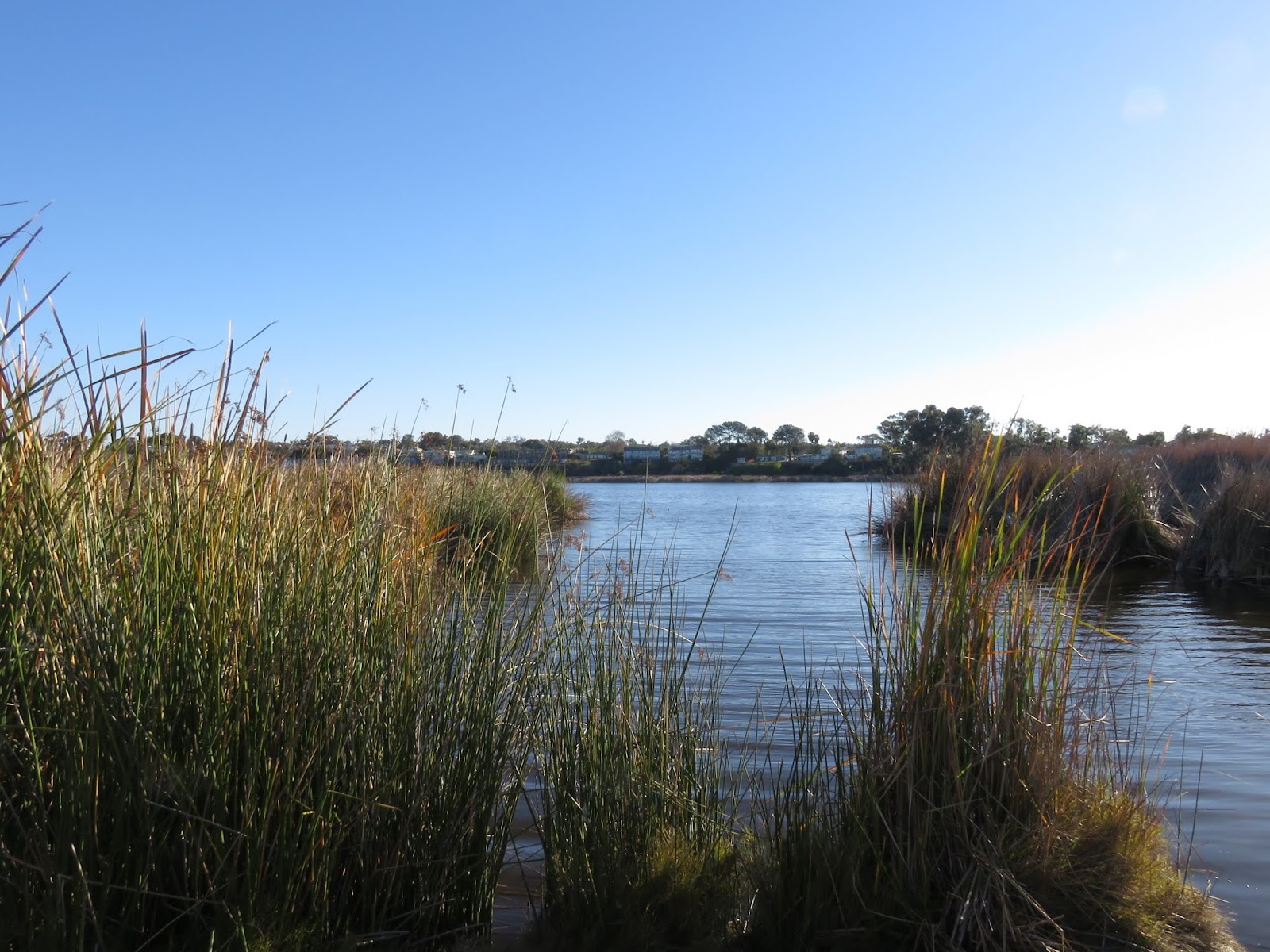
After briefly stopping by Maxton Brown Park, we headed over to the usual starting point at the lagoon. The sky was mostly clear, but it remained a bit chilly for the rest of the day. Below are four views around the lagoon.


As I was walking along the trail behind the Nature Center, I saw a Red-tailed Hawk up in a palm tree being harassed by several crows. It took off and flew right above me. The crows followed it. Below are two photos of the hawk.

Red-tailed Hawk
Red-tailed Hawk

There were several Pied-billed Grebes around the lagoon. Below are two of them.

Pied-billed Grebes

We saw a single American Kestrel. It was sitting on a streetlight above the freeway, looking around. Below is a photo of it.

American Kestrel

We also spotted a Great Egret sitting near some water right beside the road. Below is the egret.

Great Egret

At the next stop, a Great Blue Heron was crouching in the reeds, preening itself. Occasionally, it would pause and take a slow look around. Below is the heron.

Great Blue Heron

There were quite a few Western Grebes around, some sleeping and some diving. There were also a lot more Clark's Grebes than we usually see. There were a couple of Clark's Grebes with young that were nearly adults. However, the young were still pestering their parents; every time a parent came up with the fish, the young would come after it, making strange noises and begging to be fed. Below are five photos. The first two are of Western Grebes. The last three are of Clark's Grebes. The fifth photo shows one of the young following its parent.

Western Grebes
Western Grebe
Clark's Grebe
Clark's Grebe
Clark's Grebes

There were not as many warblers around as there usually are at this time of year. We did see several Orange-crowned Warblers flitting about. Below is one of them.

Orange-crowned Warbler

As usual, we saw a few Black Phoebes around. Below is one of them perched in a tree at Maxton Brown Park.

Black Phoebe

We went to the beach and saw several loons out on the ocean, as well as a couple of Eared Grebes. Below are two photos. In both photos there are two Pacific Loons on the left, and two Red-throated Loons on the right. In the first photo, the two round-looking birds in the back are Eared Grebes.

Pacific Loons, Red-throated Loons, and Eared Grebes
Pacific Loons and Red-throated Loons

There were a few Double-crested Cormorants out on the ocean. Below is a photo of one (although, in this photo, it happens to look somewhat like a Brandt's Cormorant because it has its head turned slightly).
Double-crested Cormorant

There were several Brown Pelicans flying around. Below is one of them, a very colorful adult.

Brown Pelican

We didn't see all the shorebirds that we had hoped to see by the ocean, but we did see couple of cute little Sanderlings running along the beach. Below are two photos of the tiny shorebirds.

Sanderling
Sanderling

There were a few different species of gulls at the beach. Many were clustered around a stream of water coming from the lagoon. Below are two photos. In the first photo, the four smaller gulls are Ring-billed Gulls, while the two larger ones are Western Gulls. In the second photos, the gull to the far left is a Ring-billed Gull, the two large gulls are Western Gulls, and the rest are Heermann's Gulls. there is also a Sanderling running by in the background.

Ring-billed Gulls and Western Gulls
Ring-billed Gull, Western Gulls, Heermann's Gulls, and
Sanderling

Friday, November 20, 2015

Buena Vista Lagoon October

I'm very sorry for posting so late. October 31 was the bird count at the Buena Vista Lagoon. The weather was fairly nice. The highlight of the day was a very secretive Gray Catbird, which are rarely seen here (they're an East Coast bird). Unfortunately, the catbird wouldn't come out of the bush, so I wasn't able to take a photo. Below are two views of the lagoon.


There were quite a few Pied-billed Grebes swimming around the lagoon. Below are two photos of them.
Pied-billed Grebes
Pied-billed Grebe

There were also quite a few Northern Shovelers around. Below are two of them, a female and an immature male (immature males have entirely gray heads and dull plumage).
Northern Shovelers

There were a few Eared Grebes here and there, but not very many, and not very close to us. Below is one of them.
Eared Grebe

We saw a lot of American Coots on the lagoon, which was good, since we'd been seeing only a few each month for a long while. Below is a coot.
American Coot

There were quite a few Western Grebes as well, as usual. Most were too far away to take a picture, but one did come close enough for a shot. Below is the Western Grebe.
Western Grebe

There were several Black Phoebes around. Below is one of them sitting on a fence post at Maxton Brown Park. It was diving into the flowers for insects.
Black Phoebe

As we were standing by the lagoon, looking out over the reeds and water, a flock of birds appeared in the distance. As they came closer, we saw that they were White-faced Ibises, which we don't usually see. White-faced Ibises are found year round in the southwestern United States, the western side of the Gulf of Mexico, and the southern end of South America. They are found during the summer in the western United States, and they winter in Mexico and part of Central America. They are very distinctive with their reddish-brown heads, necks, and bodies, iridescent green wings, white face, and long, down-curved bills. When we do see them, they are almost always in flocks. I've never seen them actually land in the lagoon; it's probably too deep for them. Below are two photos of the flock of ibises.
White-faced Ibises
White-faced Ibis

Another bird we saw that we don't see that often was a Blue-gray Gnatcatcher. It was hopping up on top of the bushes and making a "wee!" sound. Blue-gray Gnatcatchers are found year round in the coastal southwestern and southeastern United States as well as most of Mexico. They are found in the southwestern and eastern United States in the summer, and along the western coast of Mexico and parts of Central America and the Caribbean in the winter. They are very small, often inconspicuous birds (unless they go "wee!"). They look like miniature mockingbirds. They have bluish-gray backs, grayish-white bellies, and black and white tails. Male Blue-gray Gnatcatchers have a black V on their foreheads. The one we saw was a female. They can be confused with the Black-tailed and California Gnatcatchers, but they can be identified by their paler plumage and, in the summer, the males of the other two species have entirely black crowns, while the Blue-gray has just the small V. Below is a photo of the gnatcatcher sitting in a bush.
Blue-gray Gnatcatcher

Wednesday, October 7, 2015

Oceanside Harbor and the San Luis Rey River

On the 26 and 27 of September, I volunteered to help set up the booth for the Buena Vista Audubon Society at the Oceanside Harbor Days. Unfortunately, that meant that I wasn't able to attend the monthly bird count at the lagoon.

I did, however, take a look at the Oceanside Harbor and the mouth of the San Luis Rey River. Just like the last time I went there, there was a large group of birds and hanging out together. There were mainly California Gulls and American Coots, but there were quite a few other birds hanging around at the edges of the flock.  Below are four photos. The first is of two Black-necked Stilts, a female Blue-winged Teal, and two American Coots. The second is of the large flock of California Gulls. There are American Coots in the background, a Black-necked Stilt near the bottom left, and a group of Double-crested Cormorants in the upper right. Third photo is of the cormorants and a few immature California Gulls. The fourth is of a Black-necked Stilt and a Killdeer.
Black-necked Stilts, Blue-winged Teal, and American Coots
California Gulls, American Coots, Double-crested Cormorants,
and Black-necked Stilt
Double-crested Cormorants and California Gulls
Black-necked Stilt and Killdeer

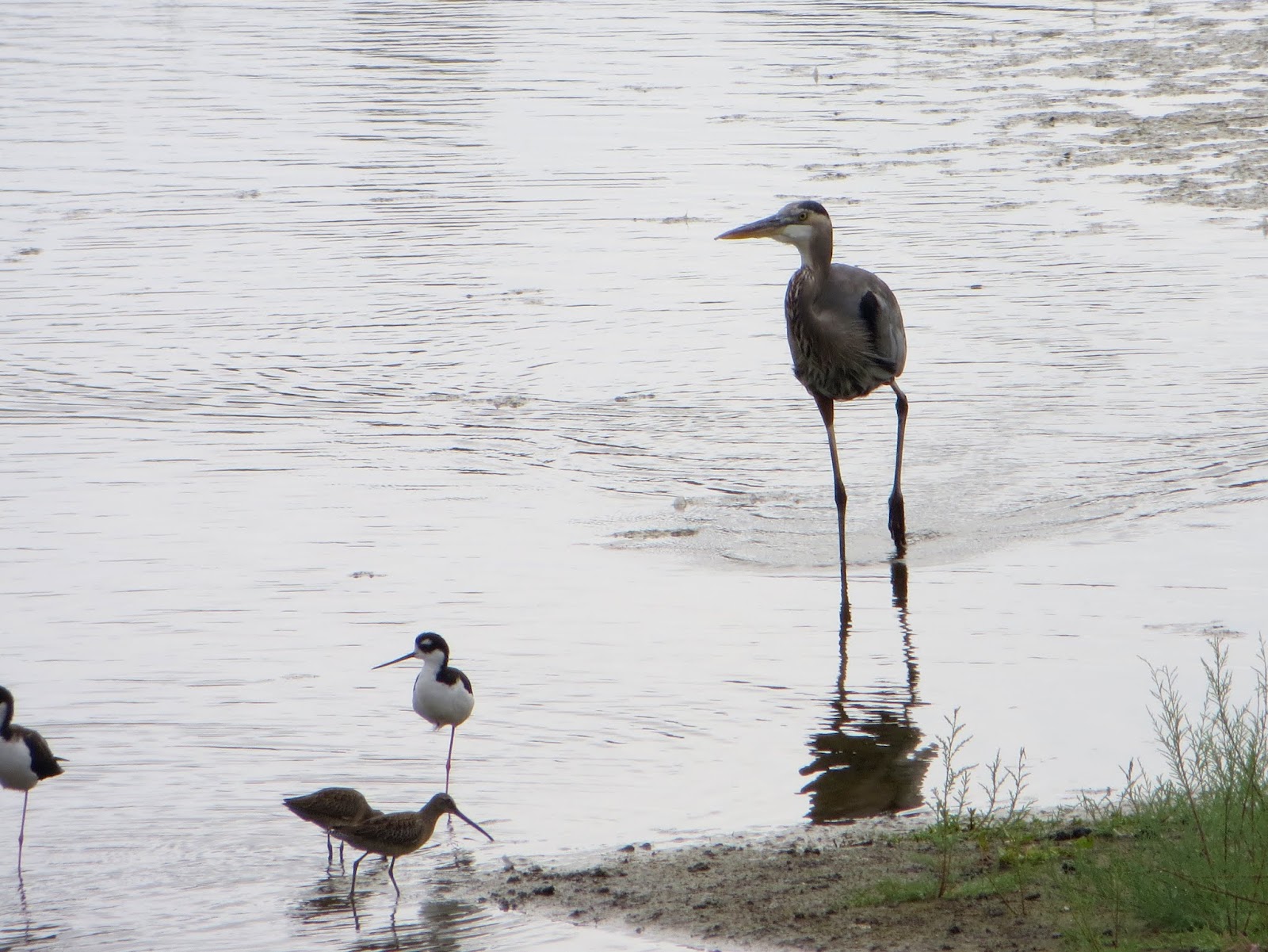
There was a little group of three Black-necked Stilts and a pair of Long-billed Dowitchers off to the side. The stilts were just standing and looking around, while the dowitchers foraged. Then, a Great Blue Heron started walking very slowly in their direction. At first, the birds didn't seem to pay any attention, but when the heron came too close, they scattered in all directions. The heron just continued on walking as if it hadn't noticed. Below are four photos. The first is of the little group of birds (the duck in the background is a female Northern Shoveler).  The second is of the birds with the heron coming up behind them, and the third is of the birds all fleeing the heron.  The fourth is of the Great Blue Heron by itself after the other birds had left.

Black-necked Stilts, Northern Shoveler, and
Long-billed Dowitchers
Black-necked Stilts, Long-billed Dowitchers, and
Great Blue Heron
Black-necked Stilts, Long-billed Dowitchers, and
Great Blue Heron
Great Blue Heron

The two Long-billed Dowitchers stayed with each other after fleeing the heron and walked and waded around the edge of the water together. Below are three photos of the pair of dowitchers.

Long-billed Dowitchers and Great Blue Heron
Long-billed Dowitchers

There were a few grebes around; Pied-billed and Eared. Below are three photos. The first two are of two different Pied-billed Grebes, and the third is of an Eared Grebe stretching its legs (notice its lobed toes - all grebes have them).

Pied-billed Grebe
Pied-billed Grebe
Eared Grebe

There were a couple of Willets wandering around. Below is one of them with an immature California Gull.

California Gull and Willet

On Sunday, there were quite a few birds in the harbor. In the early morning, an immature Black-crowned Night-heron was perched on the railing of a walkway. It sat there for a long while, looking around and preening. However, when people came swimming by, it flew away. Below are two photos of it.

Black-crowned Night-Heron

There were a lot of Brown Pelicans and Double-crested Cormorants, as well as many other birds, hanging around the harbor looking for handouts from the fishermen. When the swimmers came by, the birds just watched from their platforms. Below are six photos. The first and last are of Brown Pelicans. The second is of two Double-crested Cormorants, the third is of a pelican and four Heermann's Gulls, the fourth is of five pelicans and a Great Blue Heron, and the fifth is of two Snowy Egrets and an immature Western Gull.

Brown Pelican
Double-crested Cormorants
Brown Pelican and Heermann's Gulls
Brown Pelicans and Great Blue Heron
Snowy Egrets and Western Gull
Brown Pelicans

There were quite a few Forster's Terns flying around the harbor. Some few in flocks, while others flew by themselves. Below is a Forster's Tern.

Forster's Tern

There was a very nice-looking Belted Kingfisher in the harbor. It was landing on top of the masts of the sailboats and looking around. Below is a photo of it.

Belted Kingfisher