Sunday, February 23, 2014

February Buena Vista Lagoon

Yesterday was the monthly bird count.  The weather was pretty good, and we saw sixty-two species all together.  There were quite a few people today.  Below are two photos of the lagoon.


One of the first birds we saw was a snowy egret hunting for fish.  Below are two photos.  The first is of the snowy egret, and the second is of some small fish in shallow water.
Snowy Egret


There were many, many yellow-rumped warblers around.  Below is a male on some telephone wires.
Yellow-rumped Warbler

There were a couple of great egrets around.  There were more egrets yesterday than there have been the last few months, probably because the water level was lower.  Below are two great egrets.
Great Egret
Great Egret

A rather exciting bird was a white-tailed kite.  I hadn't seen one at the lagoon in quite a while.  White-tailed kites are found along the Pacific coast, southern Texas and Florida, and down through Mexico and South America all year round.  They can often be seen hovering over marshes and fields hunting for small mammals.  Adults are pure white below with gray wings, black shoulders, and red eyes.  Juveniles have light eyes and some brown on their chests and upper backs.  The one we saw at the lagoon just flew straight in and sat on a branch above the reeds.  Below is a photo of it.
White-tailed Kite

A duck I hadn't seen in a while was the gadwall.  Yesterday, I saw a few.  Gadwall are found in southern Canada and the central United States in the summer, and the southern United States and Mexico in the winter.  Along the Pacific coast, they are around all year.  Male gadwall are plain gray on their heads and sides, with white bellies, black rumps, and white underwings.  They also have a tan patch on their wings.  Females are similar to female mallards, but their have higher foreheads and mostly unmarked faces.  Gadwall are a little bit smaller than mallards.  Below is a male gadwall under a bridge.
Gadwall

There were several hawks around.  As we were leaving, there was a red-shouldered hawk sitting on a telephone wire eating something.  There were four upset crows sitting around it.  Below are two photos.  The first is of the hawk, and the second is of the hawk and three of the four crows (the hawk is at the bottom left).
Red-shouldered Hawk
Red-shouldered Hawk and American Crows

One man who was there spotted an Anna's hummingbird nest.  It was right next to the path, but it was very tiny and blended in very well.  We looked at it, but didn't stay too long, since the mother hummingbird was very upset.  As soon as we walked away, she went back to the nest.  Below is a photo of the nest.

Saturday, January 25, 2014

Buena Vista Lagoon January

Today was the monthly bird count.  We didn't see very many birds this time.  The weather started out somewhat cool and cloudy, but the clouds soon went away and it became quite hot.  Below are two photos I took of the lagoon.


For some reason, we've suddenly started seeing northern flickers at the lagoon.  Before now, we almost never saw flickers, but last month we saw one and today we saw three.  Northern flickers are found in Alaska and Canada in the summer and Mexico in the winter.  Throughout most of the United States, they are around all year.  They have bluish-gray heads and light brown bodies.  They have black spots on their bellies and black stripes on their backs.  Under their wings is bright red.  Males have a red malar (area on the face just below the cheek).  One of the flickers I saw let me get fairly close to it before flying a short distance away.  I was surprised at how large it was.  They're about a foot long from beak to tail.  They are also very loud.  The one I saw was calling "kew" over and over.  Below is a photo of it in a tree.
Northern Flicker

They were several common yellowthroats flitting around through the reeds and bushes.  Below is a photo of one of them.
Common Yellowthroat

There were several red-tailed hawks as well.  Below are photos of two of them.
Red-tailed Hawk
Red-tailed Hawk

Since it was such a warm day, quite a few western fence lizards came out to bask in the sun.  Below is photo of one of them.  It was watching me very carefully, and dashed into a crack in the wood when I came to close.
Western Fence Lizard

There were quite a few song sparrows around.  A few of them were singing.  Below is one of them in a bush.
Song Sparrow

There were many Anna's hummingbirds flying around.  They were chasing each other all over.  One of them, a male, came up close to me and sang its squeaky song.  Below is a photo of it.
Anna's Hummingbird

There were a couple mourning doves here and there.  Mourning doves are very nervous birds.  The one in the photo below was looking down at me and flew away when I walked underneath it.  Another one ran away from me on the ground.
Mourning Dove

There were probably over two hundred northern shovelers at the lagoon.  They were everywhere.  Below is a female swimming and 'shoveling' with its bill.
Northern Shoveler

Sunday, January 19, 2014

The Vista Village Creek

I've been visiting the Vista Village Creek in downtown Vista a few times with my parents.  I've been looking for an adult male hooded merganser.  Right now, there is almost always a female and immature male (see the bottom of this post), but I haven't seen the adult male yet.  He's been there, though, because my parents saw him once.

The Vista Village Creek is a small, artificially-made park, but sometimes there are interesting birds, especially in the early morning or when it isn't crowded.   I've seen green herons fairly close up there, and there are also the mergansers.  My parents saw Townsend's warblers there as well.  Below is a view from the park.


In the early morning there aren't many ring-billed gulls.  There are usually only two or three.  Later in the day, there are many more of them.  Below is an immature ring-billed gull.  Immature ring-bills have pink legs and beaks, a dark tip on their beak, and dark eyes.  They also have some brown on their wings.
Ring-billed Gull

Today, there was a great blue heron standing on a rock in the creek.  It just stood there for a while, looking at me.  Then it crouched down to hunt.  I don't know what it's eating there, but it caught something in the water.  Below is a photo of it.
Great Blue Heron

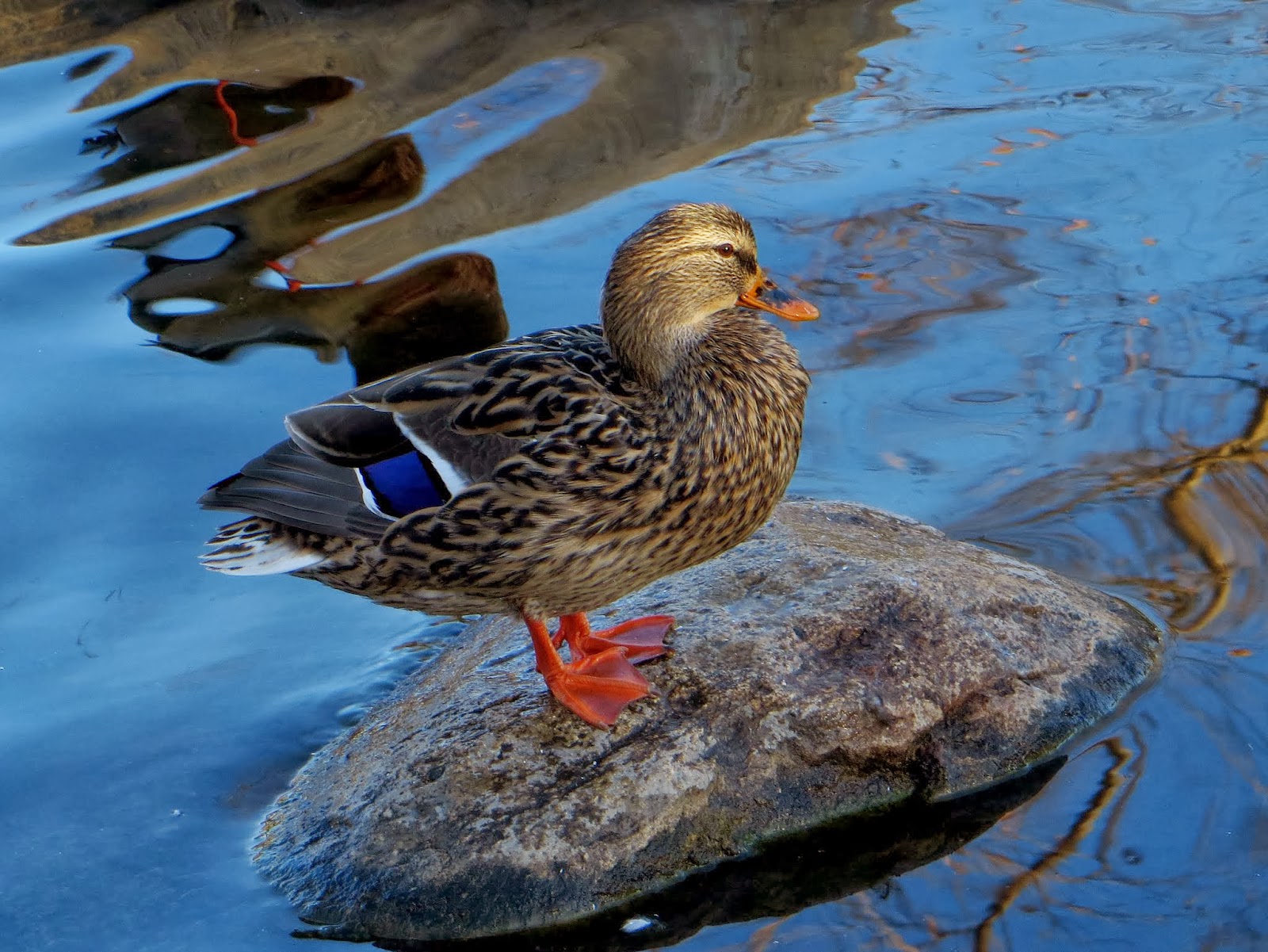
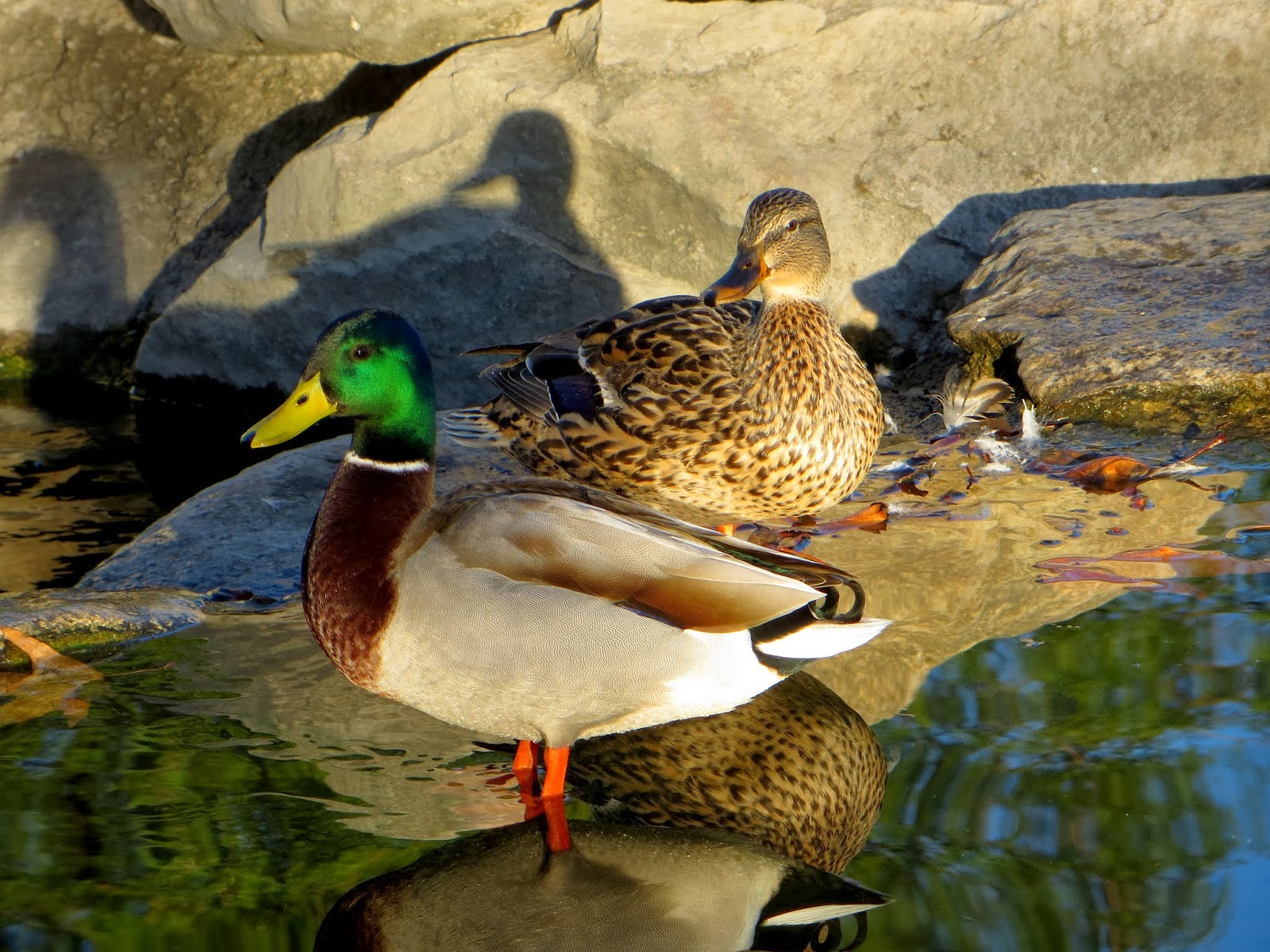
All day long, there is a large flock of mallards at the creek.  In the early morning, they are up on the grass, but as more people come by, they move to the water.  Even though mallards are common, they're still very pretty ducks, so below are a few photos I took of them.
Mallard
Mallard
Mallards

Before I saw them at the creek, I'd never seen hooded mergansers before.  Hooded mergansers are found in the southeast and west coast of the Untied States in the winter and the northeast and southern Canada in the summer.  In parts of the eastern United States, they are around all year.  Females are brownish gray with darker backs and white below.  They have a brown crest, yellow-edged beak, and dark eyes.  Immature males are similar to females, except their beaks are black and they have brown or yellow eyes.  Adult males have black backs, white bellies, reddish-brown sides, yellow eyes, and a white crest.  Both males and females are small with fairly long tails and thin beaks.  They eat small fish, crustaceans, and insects, and they nest in trees.  Below are two photos of the immature male, and a photo of the male and female.
Hooded Merganser
Hooded Merganser
Hooded Mergansers

Wednesday, January 1, 2014

Guajome Park

Yesterday my dad and I went to Guajome Park.  The sky was clear and it got pretty warm.  There were more people than usual there, but we still saw quite a few birds.

There were many, many northern shovelers there.  Many were in large, compact flocks out on the water.  Below is a male.
Northern Shoveler

I hadn't seen Canada geese at Guajome before (probably because there isn't a lot of open ground), but yesterday a flock of nine flew in and landed on the pond.  Canada geese summer in Canada and winter in the southern United States and Mexico.  They are around all year in most of the United States and parts of Canada.  Typically, they have dark necks and heads with white cheeks, gray bodies, and black tails.  However, the shade of gray, their size and the amount of white on their face can vary widely.  They're often found in open spaces such as flat marshes and golf courses.  There were many feral geese at the park as well, but the Canada stayed far apart from them, away from the shore.  Below are two photos of the Canada geese.
Canada Geese
Canada Geese

I don't think there were as many American coots as there were shovelers, but there were still a lot of them.  Below are two photos of coots.  There is also a shoveler at the top of the first photo.
American Coots and Northern Shoveler
American Coot

There were a few feral geese, as I mentioned before.  I believe they were domesticated greylag and swan geese.  (Greylag geese are brownish gray above and white below and are native to Europe.  Swan geese are brown above and white below with yellowish sides and a large lump on their foreheads and are native to Asia.)  Domesticated geese and ducks can almost always be told apart from native ones by their deep bellies.  I don't know if they are breeding or if people just keep releasing more, but no-one seems to be doing anything about them.  Below is a feral swan goose stretching its wings. 
Domesticated Swan Goose

The feral geese, coots, and ducks all hung around together near the shore, though the shovelers do not take hand-outs like the others (though bread shouldn't be given to any of them).  Below is a group of shovelers, coots, and geese.
Geese, Ducks, and Coots

There were also some great-tailed grackles looking for food (sometimes they'll join the waterfowl along the shore looking for bread).  Below is a female great-tailed grackle taking a bath.
Great-tailed Grackle

There were tons of common yellowthroats flitting about in the reeds and bushes.  Below is a male.
Common Yellowthroat

We saw one Townsend's warbler high up in a tree.  Townsend's warblers summer in western Canada, southern Alaska, and the northwestern United States.  They winter along the Pacific coast, southern Mexico, and Central America.  They have yellow faces with blacks caps, cheeks, and throats.  They have yellow chests and white bellies with black streaks on their sides.  Their backs are greenish-gray, and they have two white wing-bars.  Their boldly-marked faces are probably their most distinctive feature.  They are often found high up in coniferous trees, like the one below.
Townsend's Warbler

There were many beautiful views along the trails.  Below are a few of them.


We saw a couple of downy woodpeckers around.  Below are two photos of one of them.  The top photo shows it from the side (no spots on its sides; as opposed to a Nuttall's, which does have spots).  The bottom one shows its back and the large white patch (only downy and hairy have it).  There seem to be more downy woodpeckers at Guajome than Nuttall's, though I'm not sure why.
Downy Woodpecker
Downy Woodpecker

There was one greater roadrunner.  I think it was trying to startle some little animals to catch, because it was fluffing up its crest and tail as it hurried along.  Greater roadrunners are found year-round in the southwestern United States and Mexico.  They are large and streaked brown.  They are paler below and have a small crest.  They are often seen on the ground or on wooden posts or rocks.  They hunt lizards, snakes, small mammals and birds, and large insects.  They are related to cuckoos.  Below is a photo of the roadrunner.
Greater Roadrunner

There was a small group of killdeer running around on a hill.  There were about five of them and they were making little "ki" noises.  Below are photos of three of them.
Killdeer
Killdeer

There were a few butterflies flying around.  Below is a photo of a mourning cloak butterfly.  Two of them were fluttering around over the grass and seem to like landing on this tree stump.
Mourning Cloak Butterfly

One exciting bird for us was a red-breasted sapsucker.  Neither of us had seen one before.  Red-breasted sapsuckers summer along the western coast of Canada and winter in California.  In between along the coast, they are found year-round.  They have almost entirely red heads and chests (except for some white on their faces) and are yellowish below.  They have black and white backs and black wings with a bold white patch.  Sapsuckers, as their name suggests, eat sap.  They also eat insects and fruit like other woodpeckers.  Below are two photos of the sapsucker.  The top photo shows its back, wings, and some of its red head.  The bottom one (sorry, it's a bit blurry) shows its side and some of its head.
Red-breasted Sapsucker