Tuesday, September 15, 2015

Migrating Birds and Cooper's Hawks

A lot of birds have been visiting our backyard these past couple months. It's been especially hot this summer, and we put out several bowls of water outside, so many different birds have been coming down to drink, bathe, and cool off. Just sitting by the window, I can see quite a few species within a short period of time.

Most of the summer birds - the grosbeaks, tanagers, and orioles - are still here, and come down to the water from time to time. Below are three photos. The first is a female Black-headed Grosbeak. The second is of the same grosbeak, along with a female House Finch, both a male and a female Hooded Oriole, and a female House Sparrow. The third photo is of a female Western Tanager (which looks very similar to a female oriole, but is stockier with a thicker yellowish bill, shorter tail, and darker wings) and a California Towhee.
Black-headed Grosbeak
Black-headed Grosbeak, House Finch, Hooded Orioles, and
House Sparrow
Western Tanager and California Towhee

Little warblers have been visiting the water as well. Most often it's an Orange-crowned Warbler, but once or twice I've seen a Yellow Warbler taking a drink there. Below are three photos. The first is of an Orange-crowned Warbler and a California Towhee, and the second two are of the same Orange-crowned Warbler bathing and showing off its bright orange crown.
California Towhee and Orange-crowned Warbler
Orange-crowned Warbler

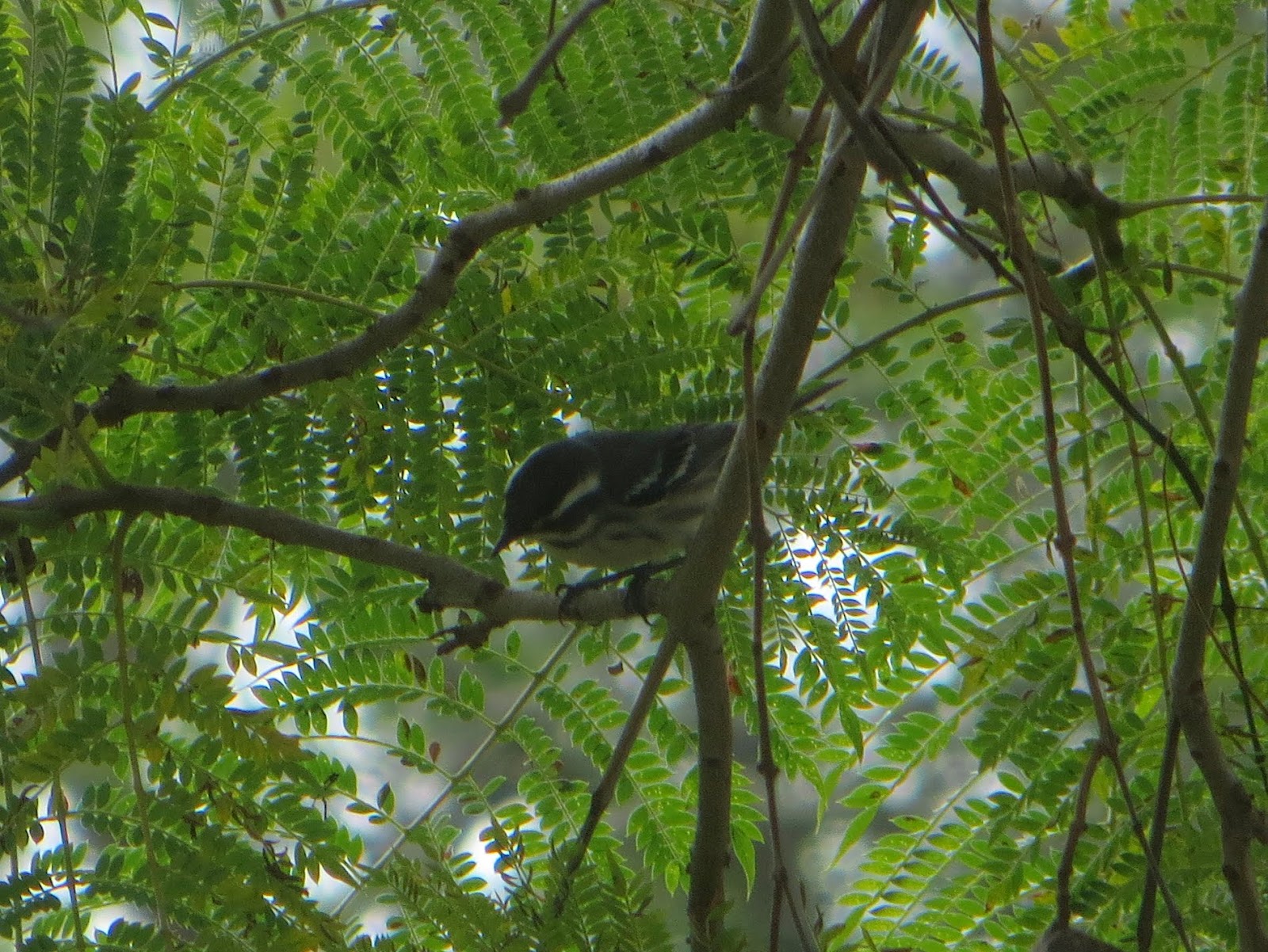
As I mentioned in my last post, a few winter birds have arrived very, very early. On Saturday, I spotted another new migrant in my yard, the Black-throated Gray Warbler. I've never seen them in my yard before, and I haven't seen them anywhere this early before. Like most of the birds in my yard, it came down to take a drink, though it didn't stay long. A couple of Mountain Chickadees also came by, though they didn't stay long enough for a photo. Although the chickadees don't migrate, I don't usually see them except in the winter. I'm still not sure why these birds have come here so early. Below are two photos of the Black-throated Gray Warbler in the jacaranda tree.
Black-throated Gray Warbler

I also saw a couple of little flycatchers on Saturday, the Pacific-Slope Flycatcher and the Western Wood-Pewee. Because of their similar size and shape, they can be confused at a distance or in bad lighting. In good lighting, the Pacific-Slope Flycatcher is clearly very yellow, while the Western Wood-Pewee is grayish-brown (it does have a small bit of yellowish-gray on its belly). Below are two photos. The first is the Pacific-slope Flycatcher, and the second is the Western Wood-Pewee.

Pacific-Slope Flycatcher
Western Wood-Pewee

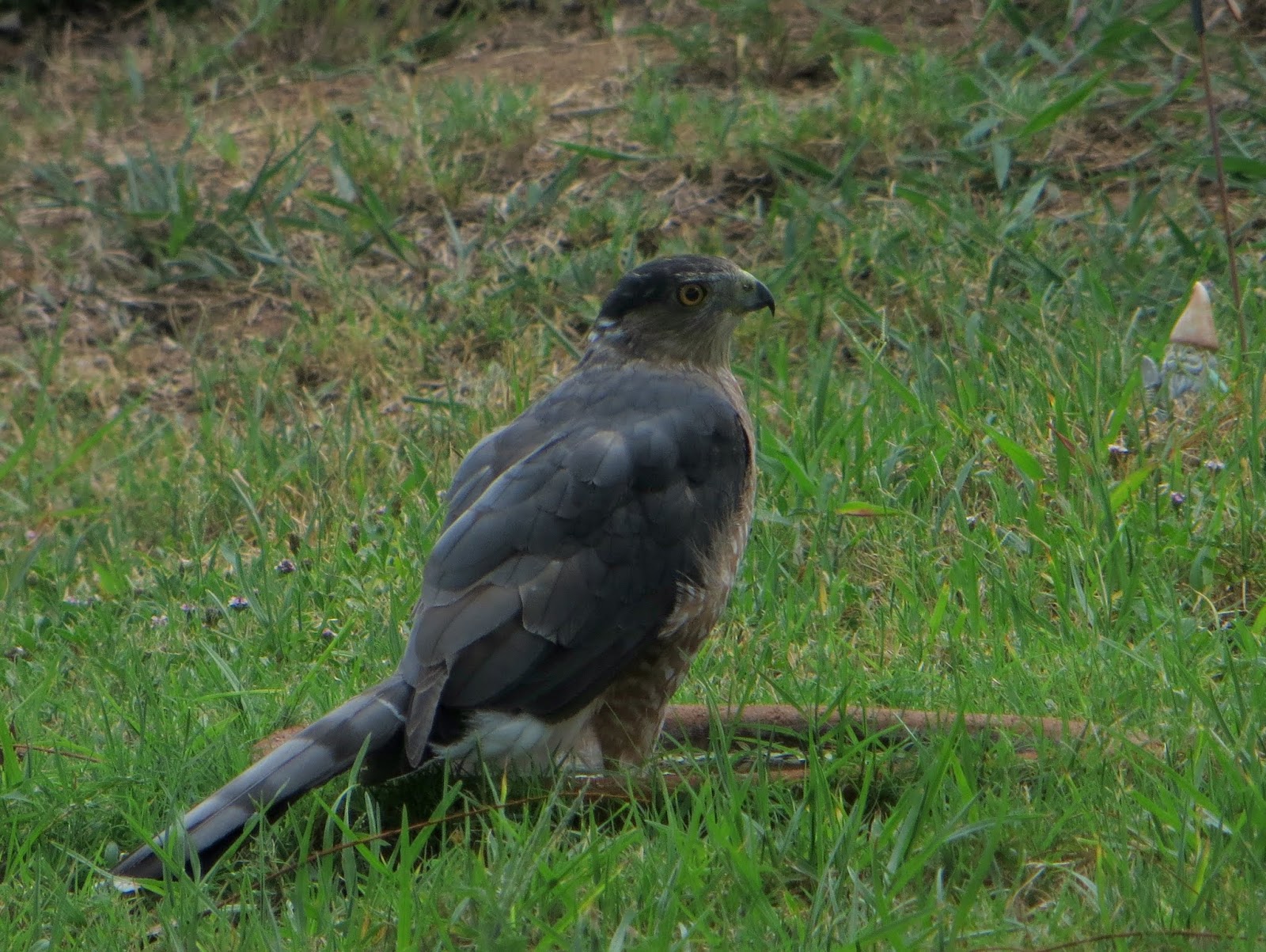
On Thursday, I was doing my homework and looked up to see an adult Cooper's Hawk standing in the middle of the yard. It was just standing in the grass, looking around. Then it raised its wings a couple of times, as if warding off anything that might be nearby. It ran to one of the clay water dishes, took a drink, and sat in the water. It stayed for quite a few minutes before taking off. However, it must have been weighed down by water or maybe it was difficult to take off from the ground, since it didn't quite make it over a bush and sort of fell into it. After it righted itself and sat for a minute or two, it flew away. Below are six photos of the Cooper's Hawk. The second and third are of it raising its wings, the fifth is it sitting in the water, and the sixth is the hawk when it fell into the bush.

Cooper's Hawk
Cooper's Hawk
Cooper's Hawk
Cooper's Hawk
Cooper's Hawk
Cooper's Hawk

On Saturday, a juvenile Cooper's Hawk came by. It was trying to hunt, and flew from perch to perch trying to find a way to get to a group of House Sparrows hiding in a bush. It was clearly very unexperienced, as it tried to jump into the bush and climb in after the birds. The hawk was way too big to fit into the dense bush, and so it fell out onto the ground. It tried a second time with the same result, then sat in an orange tree for a while before finally flying away. Below are three photos of the hawk. In the first, the hawk is sitting on a birdbath, in the second, it's on our roof, and in the third, it's in the orange tree (its bill is open because it was panting; it was very hot on Saturday).

Cooper's Hawk
Cooper's Hawk
Cooper's Hawk

Friday, September 4, 2015

Buena Vista Lagoon August

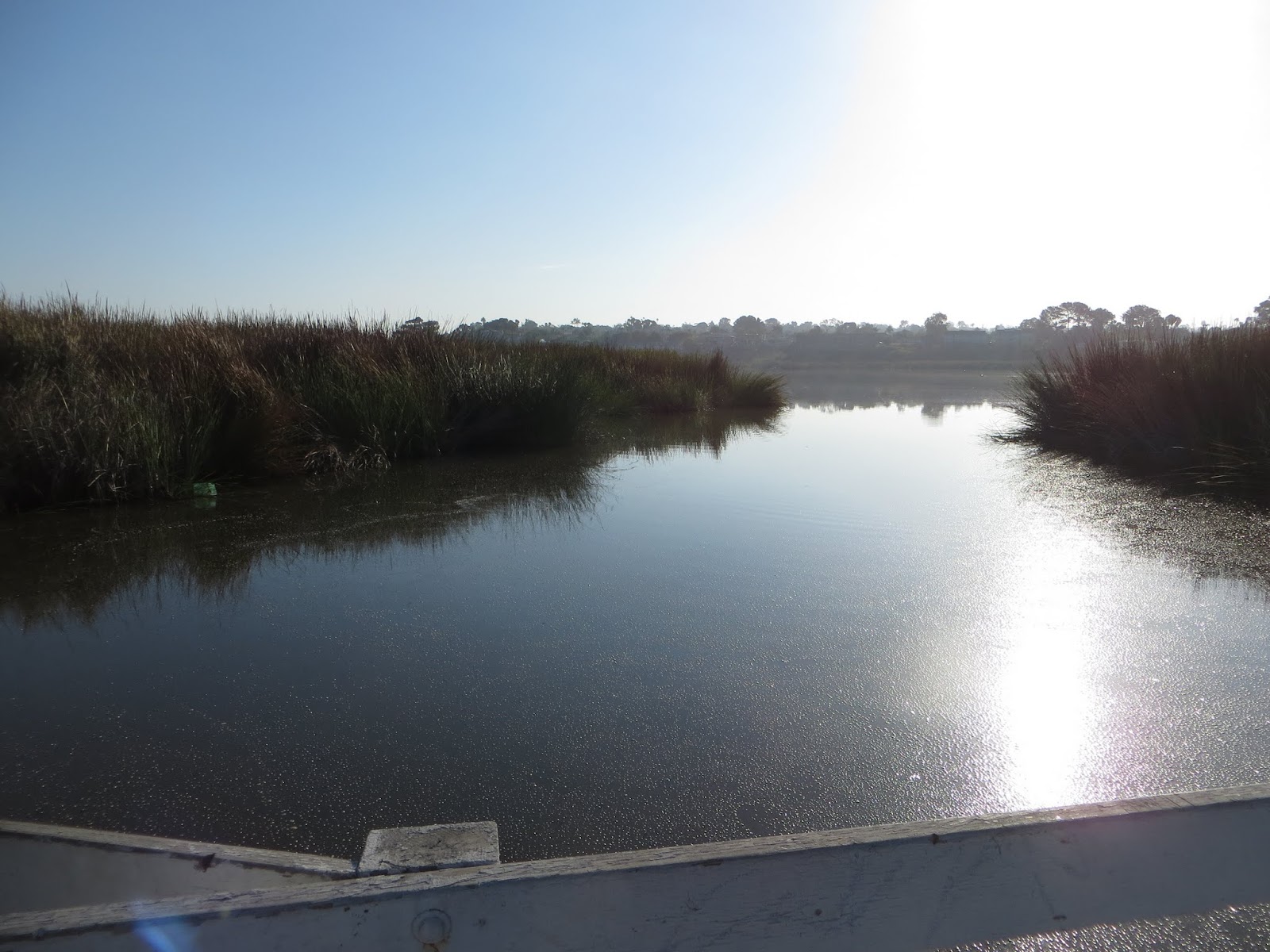
Last Saturday was the bird count at the Buena Vista Lagoon. The sky was clear, the water level was high, and it was very hot. Unfortunately, we didn't see a single raptor. However, we still managed to see more species than we did last month. Below are six views around the lagoon.


We saw several Pied-billed Grebes around the lagoon, including a couple of young ones with stripy faces. Below are two photos of the Pied-billed Grebes (the one in the second photo is a juvenile).

Pied-billed Grebes
Pied-billed Grebe

There were quite a few Red-winged Blackbirds around, flying through the reeds and eating at bird feeders. Below is a male sitting on a telephone wire.

Red-winged Blackbird

There were a few young Western Fence-Lizards sunning themselves in front of the nature center. They were very small with large heads. Below is one of them blending into a wooden railing.

Western Fence-Lizard

There were a few Mourning Doves here and there. Below is one sitting high up in a tree.

Mourning Dove

There were several Cassin's Kingbirds sitting up on the tops of trees. Their colors were very vivid in the bright sunlight. Below is one perched on top of a sycamore tree.

Cassin's Kingbird

There were a lot of different dragonflies zipping around. Below is a blue dasher dragonfly resting on a bush. Most of the dragonflies were probably blue dashers; they seem to be the most common species around.

Blue Dasher

As usual, there were quite a few American Crows around. Below is one of them perched on a lamppost.

American Crow

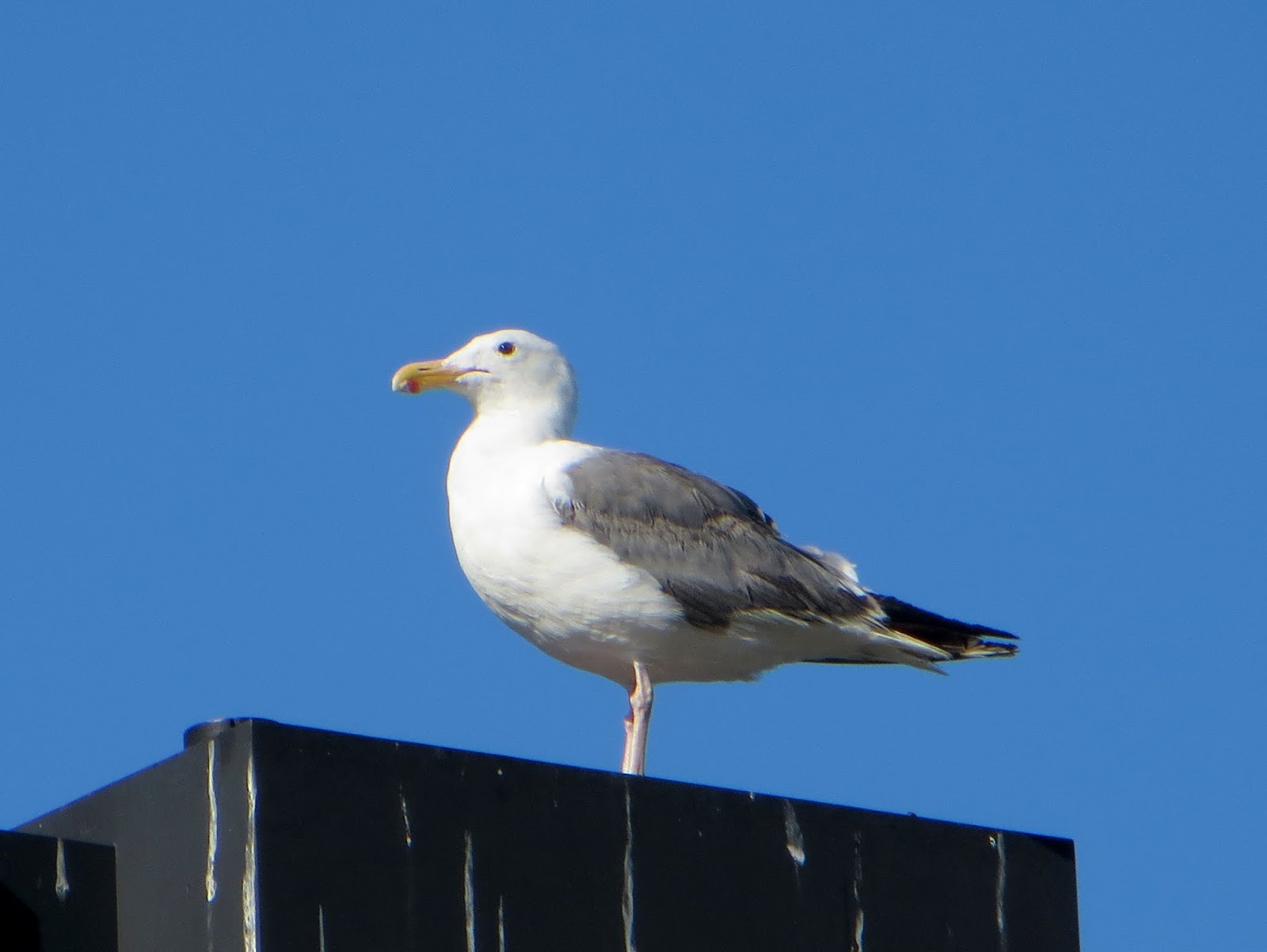
There didn't seem to be as many gulls around as usual, but there were a few here and there, mainly California and Western Gulls. Below is a California gull standing on a streetlight.

California Gull

There were a couple of Caspian Terns that flew in squawking. They flew around together and dove into the water after fish. Below are three photos of the Caspian Terns diving and flying around over the lagoon.

Caspian Tern
Caspian Tern
Caspian Tern

We saw a few herons and egrets around. A couple of Great Blue Herons stood very still in the reeds by the water. Below is one of them.

Great Blue Heron

There were a few Mallards around, though not as many as we'd recently been seeing. Below is a female standing on a pipe.

Mallard

The biggest surprise of the day was another duck. As we were standing by the lagoon, looking out over the water, a large flock of ducks flew in and around the lagoon in a wide arc. Their plumage looked a lot like female Mallards, but they weren't behaving like Mallards. They landed on the water and swam in a cluster, and as we looked through our binoculars, we saw that they were all female Northern Shovelers. Shovelers and other migratory ducks (or any migratory birds) usually don't arrive until late September or October. I've never seen birds arrive as early as August before, and I'm not sure why they're here now. Other birds have started arriving early, as well, not just the shovelers. Below is a photo of the flock of shovelers on the lagoon (there are also a few Ruddy Ducks at the edges).

Northern Shovelers

Saturday, August 1, 2015

Buena Vista Lagoon July

Last Saturday was the bird count at the Buena Vista Lagoon. In the morning, it was very cloudy, then later cleared up. It had just rained recently, so the water level in the lagoon was quite high. We didn't see many birds, since it's summer, but we did manage to see over forty species. Below are five views around the lagoon.


There were quite a few Pied-billed Grebes around. There was a mother and her three stripy young ones by the fishing bridge. I assume they're the same family from the floating nest near the road, since they were in the same spot. Below are three photos of Pied-billed Grebes (the last is of the mother and two of her young ones).
Pied-billed Grebe
Pied-billed Grebe
Pied-billed Grebes

On the other side of the road from the grebe family was a lone Great Blue Heron standing very still by the reeds. Below is a photo of it.

Great Blue Heron

A young Cooper's Hawk flew over the lagoon and landed in a tree. A group of birds immediately came to harass it. It looked around for a while, then swooped low over the reeds, startling the grebe family and making them squawk. It didn't catch anything in its swoop, however. Below is the young hawk up in the tree.

Cooper's Hawk

There were several Caspian Terns flying back and forth across the lagoon. Below are two photos of them. The one in the second photo is scratching itself behind its ear while flying (quite a feat!).

Caspian Tern
Caspian Tern

there were more Bullfrogs around than any time I can remember. Everywhere we went we could hear a group of them grunting very loudly. I startled quite a few of them just walking along the trail behind the nature center. Below is one of them.

Bullfrog

There were a few hummingbirds around, both Anna's and Allen's. Below is an Allen's Hummingbird on top of a bush.

Allen's Hummingbird

As always, there were quite a few House Sparrows in the parking lots. Below are three females in a tree.

House Sparrows

We saw a couple of Killdeer. One stood for quite a while just at the edge of the road, then ran alongside the cars. It stood surprisingly close to us. Below is a photo of the Killdeer beside the road.

Killdeer

There were many Great-tailed Grackles flying around and singing. Below is a male walking along a metal railing beside the road.

Great-tailed Grackle

A number of Mallards were swimming around, many of which appeared to be juveniles. Below are two photos of them.

Mallards
Mallards

There were a lot of fish moving around in the lagoon. There were hundreds of large fish swarming near the surface of the water. I'm not certain as to their species, but I think they may have been mullet. Unfortunately, the water was a bit too murky to take a good photo of them. Below are two photos. The first is of a couple small fish. The second is of the disturbance in the water made by the swarming fish.


There were a lot of young, fluffy gray Western Grebes following their parents around and being very noisy. Below are five photos. The first is of two young Western Grebes that had probably recently left their parents (notice their odd, patchy plumage). The second is a parent and chick I saw in the early morning. The last three are of another parent and chick we saw on the other side of the lagoon. In the last photo, though it's very difficult to see, the chick is riding on the parent's back (look for the fluffy gray head sticking out at the back of the parent's neck).
Western Grebes
Western Grebes
Western Grebes
Western Grebes
Western Grebes

There are a lot of houses down by the lagoon, and a few put out birdfeeders. Usually there isn't anything except for House Finches and House Sparrows, but on Saturday, there was a group of very nice-looking male Red-winged Blackbirds hogging all the space. They were quite a bit large than the finches and sparrows. Below are the blackbirds and some House Sparrows at one of the feeders.

Red-winged Blackbirds and House Sparrows

There were a few Clark's Grebes on the lagoon, and one popped up somewhat near us with a fish in its bill. Oddly, it didn't eat the fish. Instead, it was calling (with the fish still in its bill) and occasionally diving under the water. We didn't see what it did with the fish, but perhaps it was calling for a mate or its young. Below is the Clark's Grebe with the fish.

Clark's Grebe