Saturday, January 12, 2013

Guajome Park and Twelve Birds

Today's post is a very long one.  I went with my dad to Guajome Park in Oceanside, California.  It's very near my school, and a wonderful place to see birds and other wildlife.

We saw over forty species of birds, so I won't put a list; it would be too long with the photos I included.  Some neat birds we saw that aren't shown below are a ruby-crowned kinglet, a northern harrier, some marsh wrens, some Say's phoebes, some black-crowned night-herons, and a green heron.


Below is an American white pelican.  Usually they travel in flocks, but this one was alone.  White pelicans are very large birds, and are the larger of the two species in the United States.  The other kind, the brown pelicans, are typically found by the ocean, while white pelicans are found on freshwater lakes and lagoons.
American White Pelican
 
Below is a huge mass of northern shovelers, with a few American widgeons behind them.  The shovelers are all feeding in a giant moving blob of ducks.  They look sort of like a little island.

Northern Shovelers and American Widgeons
 
Here is a common yellowthroat.  They are common little warblers that live near water and the males wear a black mask, as seen below.

Common Yellowthroat
 

Below is a greater roadrunner.  When I first saw it, it was plain, brown, and drab.  Then, as I got closer to it, it got nervous and tried to scare me away by fluffing itself up.  However, it didn't try this for very long and hurried away.  They're fairly big birds.  I always forget how big they are.  They look smaller in photographs.
Greater Roadrunner

Below is a female phainopepla.  The males are much more impressive with black plumage and taller crests.  However, both the males and females are very nice-looking birds.
Phainopepla
 
Here is a northern flicker.  Flickers are supposed to be common, but often I have a very hard time finding them around here.  However, today I saw about five of them flicking around.  On the west coast, the birds have red under their wings, while birds on the east coast have yellow underneath.  They also have slightly different face patterns.

Northern Flicker
 
Here is a red-tailed hawk.  It's very common, but this was a pretty good photo of one in flight.
Red-Tailed Hawk
 
Below is a great-tailed grackle.  They're common birds in wetlands and in the trees in shopping center parking lots.  They're often found with blackbirds, but are much larger.  Males, like the one below, are pretty birds.

Great-Tailed Grackle
 
Below is a red-winged blackbird.  This one is pretty drab.  When they're in good plumage, they are very black with bright red and yellow shoulder patches.  The patch is a little visible in this photo.
Red-Winged Blackbird
 
Here is a photo of a large group of American coots feeding in a field.  Only a small portion of the group is visible in the photo.  When walking around on land, they look somewhat chicken-like.  However, their toes are green and much longer than a chicken's.  In water, they look like ducks, and they behave a lot like ducks.  However, they are neither chickens nor ducks; they're rails.
American Coots
 
Below is another member of the rail family, the common moorhen.  Unlike the coot, the moorhen does not form large groups or walk very far from the reeds or water.  Though they are common, they are often solitary and are shyer than coots.  They are also smaller and more colorful.  The common moorhen has recently been renamed the common gallinule, but I will just call it a moorhen.
Common Moorhen

Friday, January 11, 2013

Some Advice and the California Towhee

Today, coming home from school, I saw a white-tailed kite hovering over a field.  Unfortunately, I was in a car, and didn't have a camera, so I couldn't take a photo.  They're very beautiful white birds of prey, and hover over fields to look for their prey.


Advice

Some advice for cat owners.

If you happen to have a cat or two, and they're looking out the window and making a strange "ack-ack-ack" noise, go to the window!  It means they see some little animal outside, most likely a bird.  Many times cats are the first to see birds, so its always worth going to see what they're looking at.  My own cats have helped me see plenty of birds.
 
I never let my cats out unsupervised.  Keeping cats inside is a good idea, not only to keep them safe, but it keeps native mammals, lizards, and birds safe from them.  However, if you really want to let your cat out, try your best to supervise it and consider putting a bell on its collar to warn the prey animals.  Some cats learn to walk quietly with their bell, but it will at least help for a while.  However, the best options, in my opinion, are  not letting the cat out at all, or supervision when outside.
 
If you have an outside cat or feed a stray, you've probably noticed that it attracts other creatures, like raccoons, skunks, opossums, rats, and dogs.  Besides mammals, though, cat food attracts birds as well, so if you have a bowl, don't forget to check during the day for birds.  Also, if there is a bird, make sure there's no cat around.  Cat food provides a lot of much-needed protein for birds, so there is no need to worry that it isn't healthy; it's very healthy, especially in the cold winter, when protein is most needed.
 
 
Speaking of cat food, here is a photo of a California towhee enjoying some.  Towhees are one of the most common visitors to my cat food bowl, likely because they are used to eating protein-rich bugs.  The cat food is probably an easy, tasty, extra protein boost meal for them.  California towhees are common in brushy areas, but their range is very small.  They are found only some parts (mostly coastal) of California and Baja California, and a tiny part of southwest Oregon.  They, like other towhees, kick up leaves with their feet to reveal the bugs beneath.  The young ones occasionally do the same with cat food.  It's fun to watch.
 
California Towhee
 

Thursday, January 10, 2013

The Lark Sparrow

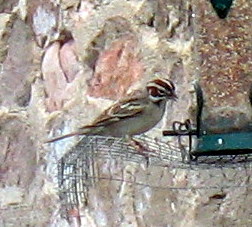
Today at school I heard a lark sparrow singing for the first time ever, and they have a beautiful, melodious trilling song.  They summer in the middle of the United States and winter in Mexico, but in my area, coastal California, and in some parts of Texas and Mexico, they're there all year round.  They live in grasslands with scattered trees and bushes.  The lark sparrow below was not at school, but at a park (still in southern California, though).  It was at a bird feeder.  Though they are fairly common at my school, I haven't been able to photograph one there.  They're beautiful birds.
Lark Sparrow

Wednesday, January 9, 2013

Advice, a Sparrow, and a Hawk

Today I didn't see any birds because I was at school.  Normally, there are some interesting birds, as my school is in a very natural area, but today I didn't see many.  I thought I saw a lark sparrow, but I'm not sure.


Advice

When photographing a bird, take as many photos as you can as quickly as you can, no matter if the bird keeps moving around.  It isn't wise to wait for a perfect pose, because the bird might only be staying in that spot for a few minutes or even seconds, so you might not get any photo.  Also, quite often between preening or eating, a bird will stick its head up, a great opportunity for a photo.  If you're clicking away on your camera, you're more likely to get a photo or two than if you're waiting for a pose, because if you're waiting, you might not be prepared.  Birds seldom stay in the same pose for very long.
 
Another tip for bird photography is that before you start your super-fast clicking, make sure your camera is focused on the bird, not the plants behind it.  Very often, I've thought that I was focusing on the bird but I actually wasn't, and took a lot of photos, but every single one of them was blurry.  So make sure to focus, and then click! click! click!
 
 
Although I didn't see any birds today, I saw some yesterday after I posted my "Six Lovely Birds" post, besides the exciting merlin.
 
I got my first good photograph of a white-crowned sparrow.  The birds just don't seem to ever hold still!  I was very lucky to get this photo below.  They are very common, but very nice-looking sparrows.  They summer in the northern United States and Canada, and winter down in the middle and southern United States (like my area) and Mexico.  They have a very nice song, and sing very often.  The one below was singing.
White-crowned Sparrow
 
On the same walk that I saw the merlin, I saw a red-shouldered hawk sitting down low on a metal fence, a very unusual spot for that kind of large hawk.  They're very beautiful hawks with bright reddish heads and bodies and black and white wings and tails with red shoulders.  They eat nearly everything; reptiles, amphibians, small mammals, and birds are all on their menu.  They're related to red-tailed hawks, both being buteos, but they're smaller.  The one below didn't seem to mind people looking at it too much, because other walkers stopped to look.
Red-shouldered Hawk

Tuesday, January 8, 2013

Merlin

I saw a merlin today in Vista, California at around 4:45 in the afternoon, just as the sun was about to go down.  A merlin is an uncommon small falcon found normally in coniferous forests with open fields, where it hunts small birds and large insects.  It is very uncommon here, as there isn't a forest, and there are few open spaces, so that's why it was exciting.  It was in a tall conifer.  Here are some photos!
Merlin


Six Lovely Birds

Yesterday and today, I've seen a lot of birds.  However, I still haven't seen or heard the hermit thrushes, and I'm a little worried that they've left.

I'll be going back to school tomorrow, because today is the last day of winter break, so I probably won't be posting as often as I've been doing.

For today's post, I'll just share some photos of the birds I've seen.  Below is another orange-crowned warbler.
Orange-crowned Warbler


Here is a black phoebe, a common flycatcher near water (occasionally they even catch little fish off the surface of the water!)  However, they're also common in other habitats, like this one.
Black Phoebe


Below, a western scrub-jay, the most common jay in my area.
Western Scrub-jay


Here, a northern mockingbird.  Mockingbirds sing long songs made up of whatever sounds they'd heard as a chick, be it birdsongs, car alarms, or howling coyotes.
Northern Mockingbird


Below, a turkey vulture, the only vulture in my area and the larger of the two species of vulture in the United States.
Turkey Vulture

Here, a Bewick's Wren, a common wren in the Southwest of the United States.  They are pretty fearless little birds, and frequently come right up to people.  They're also very loud and musical.

Bewick's Wren

Monday, January 7, 2013

More Persimmons and the Bushtit

Yesterday a sharp-shinned hawk flew over my yard.  That isn't too unusual, but I don't see the small hawks every day.  Unfortunately, it zoomed quickly overhead and was gone before I could get a camera out.

This morning, when I went out into my yard to look for birds, I didn't see any hermit thrushes, but I saw a female Nuttall's woodpecker (males have a red spot on their heads, females don't) and an orange-crowned warbler eating persimmons.  Here are photos of both of them.

Nuttall's Woodpecker

Orange-crowned Warbler

Yesterday, a flock of bushtits passed through my yard.  Bushtits are tiny, gray-brown birds that are almost always seen in flocks.  They often hang upside-down searching for aphids.  They're found on the west coast of the United States and down into Mexico.


Bushtit

Sunday, January 6, 2013

The Common Raven and Persimmons

Yesterday I saw a rather unusual sight in my backyard.  Actually, at first it was an unusual sound.  I heard a loud croaking above my head, and there they were; two common ravens.  I've seen them flying over my yard before before, but only occasionally.

Common ravens can be found in many parts of the world, and are much larger than their cousins the crows.  They are also shier than crows, prefering more natural habitats.  However, they do come into more urban areas regularly.  Here is a photo of the two that flew over my yard.

Common Ravens

One type of tree that nearly every bird in my yard loves is the persimmon tree; the kind with soft, squishy orange fruit.  So far, mockingbirds, scrub-jays, finches, warblers, waxwings, and even hummingbirds and woodpeckers love to eat the fruit.  Some birds are there all day long from sunrise to sunset.  The fruit is very tasty for people too, and can be used in cookies, jam, and other things, or can be eaten plain.

Here are two photos of birds enjoying the delicious fruit.  The first is of a house finch, and the second is of a cedar waxwing.

House Finch

Cedar Waxwing

Saturday, January 5, 2013

Two Haikus and the Same Warbler

Hello!

As well as birdwatching, I love to read and write poetry, so here are two of my haikus.


Mockingbirds singing

Sweet sounds throughout the day

And through the night too


A golden eagle

Soaring through the sunny sky

Great dark wings spread wide


Here is another photo of a yellow-rumped warbler that I couldn't resist posting!  It flew right up to me and sat still just long enough for one photo.

Another Yellow-rumped Warbler

List for Jan. 4, Some Advice, and the House Finch

Hello again!

Here's my backyard list from yesterday:

  • Red-tailed Hawk
  • Mourning Dove
  • Allen's Hummingbird
  • Anna's Hummingbird
  • Nuttall's Woodpecker
  • Cassin's Kingbird
  • Black Phoebe
  • Northern Mockingbird
  • Western scrub-jay
  • American Crow
  • Bewick's Wren
  • Bushtit
  • Yellow-rumped warbler
  • Orange-crowned Warbler
  • Hermit Thrush
  • Cedar Waxwing
  • European Starling
  • California Towhee
  • White-crowned Sparrow
  • House Finch
  • Lesser Goldfinch
  • House Sparrow
 
 
Advice
 
The best time to look for birds is in the morning.  Birds are around all day, but they're most active in the morning.  On warm days, they'll occasionally get up as early as dawn. However, on cold days, they seem to get up later; much after dawn.  For example, the birds in my yard are most active right now at 9:00, a few hours after the sun has risen.

 
The best kind of weather to look for hawks or other birds of prey is when it's warm and sunny, because they like to rise on the warm air currents to soar around and look for food.  Other birds also like warm sunny days, but they're active on cloudy days as well.
 
On days with a light rain, look for birds on telephone wires or in bushes or trees.  Birds enjoy taking a quick shower in the rain.  Taking a hose and putting your thumb on the tip to make a mist or shower can attract birds.  I've had hummingbirds come right up and take a shower in front of me.  Of course, hummingbirds are pretty fearless birds anyway.
 
 
This is a photo of a house finch.  These birds can be found throughout the United States and are common visitors at bird feeders.  This morning I saw about fifty of them in one tree.  They have a very nice little song.  This one in the picture had come to investigate the 'pst' noises I was making.


House Finch